Construction sites in Armenia: 80 workers killed in three and a half years, labour inspectors want power to halt work
- Published
- Place
- Yerevan, Armenia
- Event date
- Past event —
Summary
Eighty people have died on construction sites in Armenia in three and a half years, ten of them in the past three months. The toll, published in Yerevan on Saturday 21 November, matches other counts giving the same figure from 2023 to mid-2026. It comes in the middle of a housing boom: around 270 apartment buildings are under construction in the capital. The head of the Health and Labour Inspection Body, Slavik Sargsyan, admits the limits of his service. Inspectors can record a violation, order it to be fixed and impose a fine. But they cannot stop a dangerous site. The inspectorate has therefore proposed that the government change the law so that work can be suspended on the spot. On a single residential complex, four workers have already died.
The deadliest accident of the autumn happened on 29 September on Tychina Street in Yerevan. A tower crane being dismantled partly collapsed. Three workers were killed, including Iranian nationals. Criminal proceedings for breach of safety rules were opened the same day. More than forty days later, no one has been charged. An expert examination must establish why the crane fell and who was responsible for its condition.
It was not the site’s first accident. On the same complex, a worker was seriously injured in 2025, and another died in a fall on 20 July 2026. In total, four people have lost their lives there.
Three weeks after the crane collapse, on 19 October, a 65-year-old worker fell from the 10th floor into a lift shaft on a site on Fuchik Street. He died in the ambulance.
Who is responsible?
The law puts safety on the employer: the developer, the main contractor or the subcontractor. It must train workers, provide helmets, harnesses, goggles and ear protection, and mark off dangerous areas. The developer is not, however, free of all responsibility.
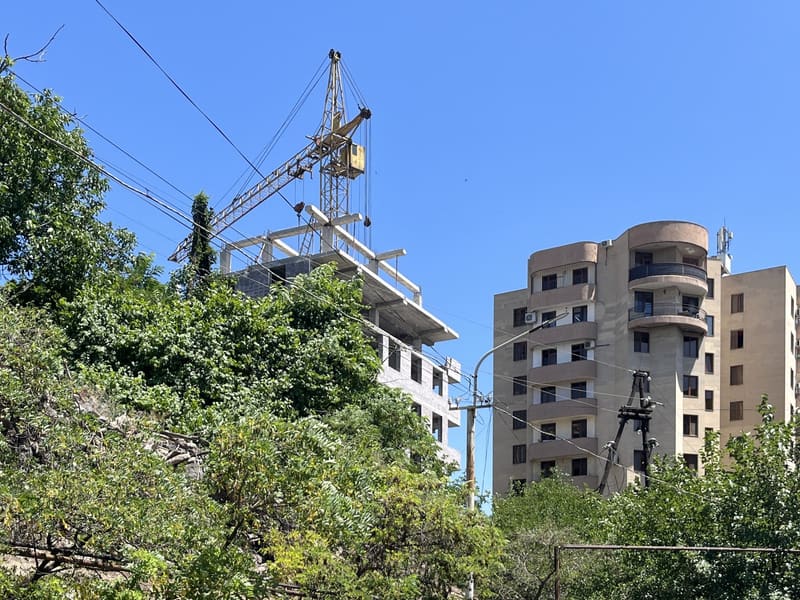
On the ground, this falls short. On about ten Yerevan sites observed this week, workers wore helmets and protective clothing at only a handful. Open floor edges were mostly not even marked with tape.
An inspectorate that cannot stop work
According to Slavik Sargsyan, his service has carried out more than 8,000 inspections in three years, only about 300 of them at construction companies. The most common violations: no protective equipment, no compulsory medical check, poorly informed workers and no designated safety officer.
Faced with a hazard, an inspector can only order the problem to be fixed. A fine comes only if the order is ignored. Hence the proposal sent to the government: allow work to be suspended immediately in case of a serious violation. No bill has yet been tabled in parliament.
Analysis
Construction is now driving Armenian growth: up 20.2% in the third quarter. But safety is not keeping pace with the cranes. One death every sixteen days on average over three and a half years, one every nine days this autumn: the trend is getting worse. The problem is as much legal as physical. An inspectorate that can neither stop a site nor fine straight away carries little weight with developers in a hurry. What happens to its proposal will show whether the government really wants to change things.
Possible consequences
The government must say whether it adopts the inspectorate’s proposal and sends it to parliament. In the Tychina Street crane case, the expert findings are awaited, with no date announced.