The history of Artsakh (Nagorno-Karabakh): from antiquity to the 2023 exodus
A province of ancient Armenia. Some of the finest monasteries in the Caucasus. Armenian princes who stayed autonomous for centuries. Then a century of conflict, two wars, a blockade, and the departure of almost all its Armenian inhabitants in a single week. This is the long history of Artsakh, which the world calls Nagorno-Karabakh.
- Published
- Facts as of
Artsakh or Karabakh?
The name depends on who is speaking. Armenians say Artsakh. The word Karabakh, “black garden” in Turkish and Persian, appears in the Middle Ages. “Nagorno” means mountainous: the upland part, where the Armenians lived. The territory is internationally recognised as part of Azerbaijan. Each of these words carries a memory. Here, we tell the facts.
Antiquity and the Middle Ages: an Armenian land
A province of the kingdom of Armenia
In antiquity, Artsakh was the tenth province of the kingdom of Armenia. It belonged to it from the 2nd century BC until 387 AD.
It is a land of mountains and forests, at the eastern edge of the Armenian plateau. It is bordered by Syunik to the west, Utik to the east and the Araxes river to the south.
387: the partition and Caucasian Albania
In 387, Rome and Persia divided Armenia between them. Artsakh and Utik were detached from the kingdom. They came under a neighbouring kingdom, Caucasian Albania, which Armenians call Aghvank. This kingdom has nothing to do with Albania in the Balkans. It was a vassal of Sassanid Persia.
This point is highly political today. Baku presents Caucasian Albania as the ancestor of Azerbaijan, and part of the region’s Christian heritage as “Albanian”. Specialist historians such as Robert Hewsen describe a kingdom made up of many peoples, but one in which Artsakh and Utik remained Armenian-speaking. In the 5th century, the historian Movses Khorenatsi placed the “boundary of Armenian speech” on the Kura river. In the 7th century, the Armenian atlas Ashkharhatsuyts still listed Artsakh among the provinces of Armenia, “now detached”.
Mesrop Mashtots and the school of Amaras
Christianity left a lasting mark on the region. According to medieval chroniclers, Saint Gregory the Illuminator founded the monastery of Amaras at the start of the 4th century. His grandson, Saint Grigoris, is buried there.
At the start of the 5th century, Mesrop Mashtots, the inventor of the Armenian alphabet, opened at Amaras the first school in Artsakh to teach in his script. Medieval sources also credit him with creating an alphabet for the Albanian language.
The princes of Khachen, Gandzasar and Dadivank
From the 7th to the 9th century, the region was under Arab rule. Then Armenian princes took back control. The principality of Khachen dominated Artsakh from the 12th century. The Hasan-Jalalyan family ruled it from 1214.
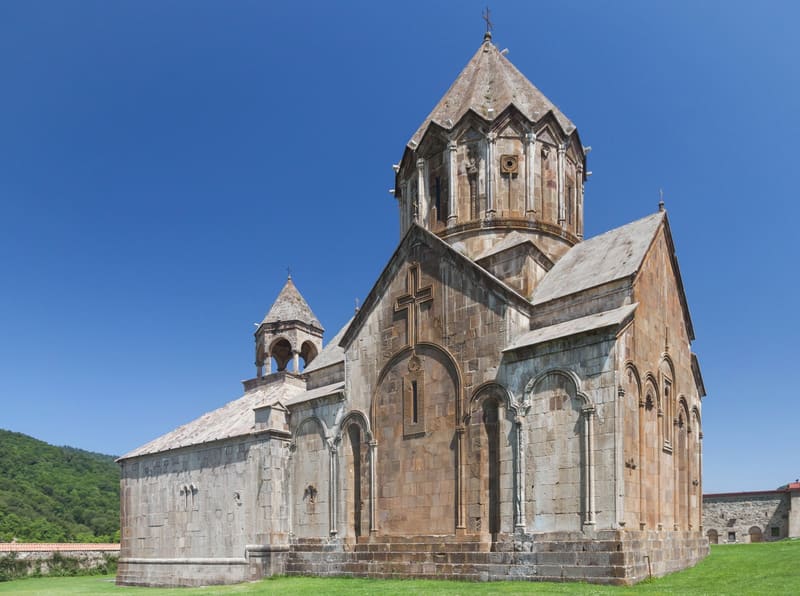
This was the golden age of the monasteries. At Dadivank, the cathedral was built in 1214. A bas-relief shows Princess Arzu offering the church in memory of her sons. At Gandzasar, Prince Hasan-Jalal Dawla had the main church built between 1216 and 1238. It was consecrated on 22 July 1240, in the presence, according to the sources, of some 700 priests. Gandzasar became the seat of the Catholicos of Aghvank, the head of the region’s Church, attached to the Armenian Apostolic Church.
Then came the Mongols in the 13th century, and Tamerlane in 1387. Amaras was looted, destroyed and rebuilt. But the Armenian princely families held on in the mountains.
The melikdoms, the khans and the arrival of Russia
The five melikdoms
From the 15th century, local power passed to five Armenian principalities: the melikdoms. The Arabs called them Khamsa, “the five”. They were Gulistan, Jraberd, Khachen, Varanda and Dizak. Each was ruled by a family of meliks, a noble title. Several descended from the Hasan-Jalalyans.
The meliks had their own fortresses and troops. They were almost always semi-independent, often under the distant suzerainty of Persia.
The Karabakh khanate
In 1747, on the death of the Persian shah Nader Shah, a chief of the Turkic Javanshir tribe, Panah Ali Khan, seized most of Karabakh. He was appointed khan in 1748. He allied with one of the meliks, Shahnazar II of Varanda, and subdued the others. Together they had the fortress of Shushi built, which became the capital of the khanate.
The khanate was Muslim, but the mountains remained Armenian. According to a Russian administrative survey of 1823, the five districts of the former melikdoms were then about 97% Armenian.
From the Treaty of Kurekchay to the Treaty of Gulistan
At the end of the 18th century, Russia was advancing into the Caucasus. In May 1805, Ibrahim Khalil Khan signed the Treaty of Kurekchay, accepting Russian authority over the khanate’s foreign affairs.
On 24 October 1813, the Treaty of Gulistan ended a war between Russia and Persia. Persia ceded the region to the Russian Empire. In 1822, the last khan fled to Persia and the khanate was abolished. The melik principalities disappeared the same year.
Under the Empire, Shushi became a major city of the Caucasus, with an Armenian quarter and a Muslim quarter. It was a centre of Armenian culture as well as Azerbaijani culture.
1905 and 1918–1920: the first modern massacres
The Armenian–Tatar war of 1905–1906
The Russian revolution of 1905 weakened imperial authority. Clashes broke out across the Caucasus between Armenians and “Tatars”, the name then given to Azerbaijanis. Baku, Nakhichevan, Shushi and Elisavetpol were affected. Estimates put the number of dead at between 3,100 and 10,000, and several hundred villages, both Armenian and Tatar, were looted.
1918–1920: two republics, one disputed territory
In 1918, the Russian Empire collapsed. Armenia and Azerbaijan became independent republics. Both claimed Karabakh. The region’s Armenians formed their own councils and rejected Baku’s authority.
In 1919, the British, present in the region after the First World War, accepted Baku’s appointment of a governor-general, Khosrov bey Sultanov. In August 1919, the Armenians of Karabakh provisionally accepted Azerbaijani authority in exchange for broad autonomy. The agreement was soon violated.
March 1920: the Shushi massacre
In March 1920, an Armenian uprising failed. From 22 to 26 March, the Armenian quarter of Shushi was looted and burned. Its people were killed or driven out. The exact toll is not known. A report by the Armenian government of the time, cited by the historian Richard Hovannisian, speaks of 500 dead in the town. Other estimates, for the town and the surrounding area, range from several thousand to far more. Shushi, a mostly Armenian town before 1920, became an almost entirely Azerbaijani one.
A few weeks later, in April 1920, the Red Army entered Baku. The Caucasus became Soviet.
The Soviet period: autonomy under supervision
July 1921: the Kavbiuro decision
The Bolsheviks entrusted the fate of the disputed territories to the party’s Caucasian Bureau, the Kavbiuro. The new Soviet authorities in Baku had at first suggested that Karabakh would go to Soviet Armenia.
On 4 July 1921, in Tiflis, the Kavbiuro voted 4 to 3 to attach Nagorno-Karabakh to Armenia. The next day, it reversed its decision. The region would stay in Soviet Azerbaijan, with broad autonomy. The official reason cited peace between Muslims and Armenians and economic ties with the lowlands. Historians stress the role of the Azerbaijani leader Nariman Narimanov, and the support he reportedly received from Stalin, then People’s Commissar for Nationalities.
1923: the autonomous region
On 7 July 1923, the Nagorno-Karabakh Autonomous Oblast was created. It covered 4,161 km². Its capital became Stepanakert, named in honour of the revolutionary Stepan Shahumyan. The region had no common border with Soviet Armenia: a strip of land around Lachin separated them.
In the 1926 census, Armenians made up 89.2% of its 125,000 inhabitants. By 1989, they were only 76.9%. Historians cite several causes: a Baku policy that encouraged Azerbaijanis to settle there, the departure of many young Armenians, and a higher birth rate among Azerbaijanis.
The petitions
Throughout the period, Armenians asked Moscow for the region to be transferred. In 1945, the head of Soviet Armenia, Grigory Arutyunov, wrote to Stalin. In 1963, about 2,500 Karabakh Armenians signed a petition to Khrushchev. In 1965, on the 50th anniversary of the genocide, large demonstrations took place in Yerevan and the Karabakh question was raised. In 1966, nearly 1,900 Armenian intellectuals, including the painter Martiros Saryan and the poet Paruyr Sevak, signed an appeal. Each time, Moscow said no.
1988–1994: from awakening to war
The Karabakh movement
With Gorbachev’s glasnost, people began to speak out. On 20 February 1988, the regional soviet of Nagorno-Karabakh voted 110 to 17 to request transfer to Soviet Armenia. In Yerevan, hundreds of thousands of people demonstrated. Moscow refused.
Violence came very quickly. On 22 February, near Askeran, clashes left two Azerbaijanis dead. From 27 to 29 February, in Sumgait, an industrial town near Baku, mobs attacked Armenians. The official Soviet toll was 32 dead. Other estimates are higher. The Soviet army intervened only on the third day.
A two-way exodus began. Armenians left Azerbaijan, and Azerbaijanis left Armenia. In November 1988, violence struck the Armenians of Kirovabad (now Ganja) and the Azerbaijanis of Gugark, in Armenia. In January 1990, a pogrom targeted the Armenians still living in Baku. It killed about 90 people, according to the British journalist Thomas de Waal. The Soviet army then entered the city, and its crackdown, known as “Black January”, killed more than a hundred Azerbaijani civilians.
Independence and war
On 2 September 1991, the Armenians proclaimed the Nagorno-Karabakh Republic. On 26 November, Baku abolished the region’s autonomy. On 10 December, a referendum boycotted by Azerbaijanis approved independence. No state would ever recognise it, not even Armenia.
The USSR ceased to exist at the end of 1991. Open war began. Stepanakert was shelled from Shushi and from Khojaly, which had the region’s only airport.
On 26 February 1992, Armenian forces took Khojaly. Azerbaijani civilians fleeing the town were killed in large numbers. Human Rights Watch counts at least 161 civilians killed. The Azerbaijani authorities give a figure of 613. It was the deadliest massacre of that war. In April 1992, in Maragha, it was Armenian civilians who were killed during an Azerbaijani attack.
On 8 and 9 May 1992, Armenian forces took Shushi. On 18 May, they took Lachin and opened a corridor to Armenia. In the summer of 1992, an Azerbaijani counter-offensive retook nearly half of Karabakh. Then the front turned. In 1993, Armenian forces took Kelbajar, then Aghdam, Fizuli, Jabrayil, Kubatly and Zangilan. They now controlled seven Azerbaijani districts around Karabakh, about 9% of Azerbaijan’s territory outside Karabakh. In 1993, the UN Security Council passed four resolutions (822, 853, 874 and 884) calling for an end to the fighting and the withdrawal of occupying forces.
The 1994 ceasefire
On 5 May 1994, with Russia as mediator, the parties signed the Bishkek Protocol. The ceasefire took effect on 12 May.
The toll was heavy. Western and Russian estimates speak of 25,000 to 30,000 dead. Between 300,000 and 500,000 Armenians left Azerbaijan or the combat zones. More than 600,000 Azerbaijanis, driven out of Armenia, Karabakh and the surrounding districts, were displaced. On both sides, entire families lost everything.
1994–2020: the frozen conflict
Thirty years of negotiations
Negotiations were entrusted to the Minsk Group, created in 1992 by the CSCE, which later became the OSCE. From 1997, it was co-chaired by France, Russia and the United States. Several plans followed one another. No agreement was signed.
Meanwhile, the self-proclaimed republic built its institutions. In 2017, a new referendum gave it the official name of Republic of Artsakh. But no one recognised this state. The front line remained one of the most militarised in Europe, and gunfire regularly killed soldiers there.
April 2016: the four-day war
From 1 to 5 April 2016, the worst fighting since 1994 broke out along the line of contact. Azerbaijan retook a few heights. Baku announced 31 soldiers killed, and the Armenian defence ministry published the names of 92 dead, soldiers and civilians. The war was short, but it showed that the military balance was shifting. Azerbaijan, enriched by oil and gas, had armed itself heavily, notably with drones.
2020: the 44-day war
The offensive
On 27 September 2020, Azerbaijan launched an offensive along the entire front line. The fighting lasted 44 days. The Azerbaijani army’s Turkish and Israeli drones destroyed much of the Armenian armour and artillery. Turkey openly backed Baku.
Towns were hit on both sides. Stepanakert was shelled, including with cluster munitions. On 8 October, the Holy Saviour Ghazanchetsots Cathedral in Shushi was struck twice. Human Rights Watch considered the attack probably deliberate. For their part, missiles fired from Armenian positions struck Ganja and Barda, in Azerbaijan, killing dozens of civilians. Human Rights Watch condemned these as unlawful strikes too.
The fall of Shushi and the 9 November statement
Azerbaijani forces advanced from the south, took Hadrut, then moved up towards Shushi. The town fell on 8 November. It lies about fifteen kilometres from Stepanakert, on the road to Armenia.
On the night of 9 to 10 November, Nikol Pashinyan, Ilham Aliyev and Vladimir Putin signed a statement that stopped the war. Azerbaijan kept what it had taken. Armenia handed over the districts of Aghdam, Kelbajar and Lachin. About 2,000 Russian troops were deployed along the line of contact and the Lachin corridor, for five years.
According to official figures from both countries, 3,825 Armenian and 2,906 Azerbaijani soldiers were killed. Dozens of civilians died on each side. In Armenia, the shock was immense.
After the war, the pressure continues
Peace did not come. Armenian prisoners remained in detention in Baku. On 13 and 14 September 2022, Azerbaijan struck several Armenian towns and villages, including Jermuk. Armenia counted 207 dead and missing, and Azerbaijan 80 soldiers killed.
2022–2023: blockade, offensive, exodus
Nine months of blockade
On 12 December 2022, Azerbaijanis presenting themselves as environmental activists blocked the Lachin corridor, the only road between Armenia and Karabakh. About 120,000 Armenians were then living in the region. The Russian troops did not intervene.
Gas and electricity from Armenia were cut several times. On 22 February 2023, the International Court of Justice ordered Azerbaijan to ensure free movement along the corridor in both directions. On 23 April 2023, Baku set up a military checkpoint on the Hakari bridge, at the entrance to the corridor. From June, nothing got through, not even the Red Cross. By the end of the summer, the shelves were empty. Bread was rationed, and fuel and medicine ran short.
19 and 20 September 2023
On 19 September 2023, Azerbaijan launched what it called “anti-terrorist measures”. The next day, the local Armenian forces accepted a ceasefire that provided for their disarmament. Baku announced 192 soldiers killed. The Karabakh authorities counted at least 200 dead on their side, including civilians.
A week to leave
On 24 September, the first families set off for Armenia. On 25 September, near Stepanakert, a fuel depot exploded while hundreds of people were queuing to fill up before leaving. Initial reports spoke of more than 170 dead. The final toll established by Armenia’s Investigative Committee is 218 dead.
On 3 October, the Armenian government counted 100,617 people who had arrived from Karabakh. That was almost the entire Armenian population of the region. Armenia speaks of ethnic cleansing. Azerbaijan says it guaranteed the rights of those who wanted to stay.
The end of the republic
On 28 September 2023, the president of the self-proclaimed republic, Samvel Shahramanyan, signed a decree dissolving all its institutions as of 1 January 2024. In December, in exile in Yerevan, he said the decree had no legal value. But the republic no longer had any territory or inhabitants.
Its leaders were arrested. On 27 September 2023, the former state minister Ruben Vardanyan was detained at the Lachin checkpoint as he tried to reach Armenia. In early October, three former presidents, Arkadi Ghukasyan, Bako Sahakyan and Arayik Harutyunyan, and the former speaker of parliament Davit Ishkhanyan were arrested in turn. On 5 February 2026, a military court in Baku sentenced five defendants, including Arayik Harutyunyan, to life in prison, and others to long terms. On 17 February, Ruben Vardanyan was sentenced to 20 years in prison.
In June 2024, the Russian troops left the region, before the end of their mandate.
Today: a displaced people, an endangered memory
The displaced in Armenia
The Armenians of Karabakh now live in Armenia, in the country’s towns and villages. Many have had to start again from nothing. The Armenian state pays them a monthly allowance, which still went to 46,000 people in October 2026. A housing programme helps them buy a home: 9,042 certificates have been approved, covering about 37,000 people, and 5,372 families have already used them.
The heritage
The region’s Armenian heritage includes hundreds of churches, monasteries, cemeteries and khachkars, the carved stone crosses. On 7 December 2021, the International Court of Justice ordered Azerbaijan to prevent and punish acts of vandalism and desecration against this heritage.
Since 2021, the research group Caucasus Heritage Watch, based at Cornell and Purdue universities, has monitored these sites using satellite imagery. By spring 2025, it had established that 14 heritage sites had been destroyed and 14 others damaged. Among them, in Shushi, the church of Saint John the Baptist, known as Kanach Zham, the “green church”, and the Ghazanchetsots cemetery. The nearby village of Karin Tak has been razed. Gandzasar and Dadivank are still standing. But Armenians no longer have free access to them, and Baku presents part of this heritage as “Albanian”.
The peace process
On 8 August 2025, at the White House, in the presence of Donald Trump, the foreign ministers of Armenia and Azerbaijan initialled the text of a peace agreement. Nikol Pashinyan and Ilham Aliyev signed a joint declaration. It provides in particular for a transit route across southern Armenia, named the “Trump Route for International Peace and Prosperity” (TRIPP). At the request of both countries, the OSCE closed the Minsk process in September 2025, a closure completed at the end of the year.
More than a year later, in November 2026, the treaty has still been neither signed nor ratified. Azerbaijan first demands that Armenia change its Constitution, whose preamble refers to the 1990 declaration of independence, itself linked to Karabakh. A constitutional reform is being prepared in Yerevan, with a referendum envisaged in 2027. But in the 7 June 2026 election, Nikol Pashinyan’s Civil Contract party won 64 of 105 seats, short of the two-thirds majority needed to put a new Constitution to the vote on its own. The initialled text mentions neither Nagorno-Karabakh nor the return of its inhabitants.
Conclusion: what remains
Artsakh has known the kings of Armenia, the princes of Khachen, the meliks, the khans, the tsars and the Soviets. It survived the Mongols, Tamerlane and the massacres of the 20th century. Throughout that time, Armenians lived, prayed and tended their vineyards there.
In 2023, in a single week, that presence almost vanished. Yet it has not disappeared. It lives on in the families now settled in Yerevan, Goris or Abovyan, in the names of villages passed on to children, in the photos of Gandzasar hanging on the walls.
This is not the story of two peoples condemned to hate each other. Azerbaijanis, too, were driven from their homes, and their families also carry their grief. Above all, it is a story of what wars cost when politics fails. A peace signed one day between Yerevan and Baku will not give Karabakh back to its Armenian inhabitants. But it could at least protect what remains: the living, and the stones.
Further reading
Our related explainers and stories:
- Nagorno-Karabakh explained: from 1923 to the 2023 exodus
- Armenia-Azerbaijan peace agreement: what it says and where it stands
- The Armenian Genocide: what you need to know
- The Armenian alphabet and language: the essentials
- Displaced Karabakh Armenians: monthly aid extended to June 2027, new jobs programme in January
- Six years after the 9 November 2020 statement, the Artsakh Public Council demands answers from Moscow and Yerevan
Frequently asked questions
Why is Artsakh considered a historic Armenian land?
In antiquity, Artsakh was the tenth province of the kingdom of Armenia, until 387. In the Middle Ages, Armenian princes built Dadivank (1214) and Gandzasar (consecrated in 1240) there, and five Armenian melikdoms kept their autonomy until 1822.
How did Nagorno-Karabakh end up in Soviet Azerbaijan?
On 4 July 1921, the Bolshevik party’s Caucasian Bureau voted to attach it to Armenia, then reversed its decision the next day. The Nagorno-Karabakh Autonomous Oblast was created inside Soviet Azerbaijan on 7 July 1923.
How many Armenians left Nagorno-Karabakh in 2023?
After Azerbaijan’s offensive of 19 and 20 September 2023, the Armenian government had counted, by 3 October, 100,617 people arriving from Karabakh: almost the entire Armenian population of the region.
Where does peace between Armenia and Azerbaijan stand in November 2026?
The text of a peace agreement was initialled at the White House on 8 August 2025, but it has still been neither signed nor ratified. Azerbaijan first demands a change to Armenia’s Constitution. The text mentions neither Nagorno-Karabakh nor the return of its inhabitants.