Armenians in France: history and landmarks
France is home to one of the largest Armenian communities in the diaspora. Its history mainly begins in the 1920s, when survivors of the genocide arrived through the port of Marseille.
- Published
- Facts as of
After the genocide: arriving through Marseille
In November 1922, the liner Tourville landed the first 400 Armenian refugees in Marseille. According to France’s National Museum of Immigration History, about 58,000 Armenian refugees arrived through Marseille between 1922 and 1924.
Many passed through Camp Oddo, in the northern districts of Marseille, where 5,541 refugees were registered between 1922 and 1927. From May 1924, stateless Armenians could obtain the Nansen passport, created by the League of Nations for refugees.
They then settled where there was work: in Marseille, in the Rhône valley (Lyon, Décines, Valence), around Paris (Alfortville, Issy-les-Moulineaux) and on the Riviera. Other Armenians came later, notably from Lebanon in the 1970s.
Churches across France
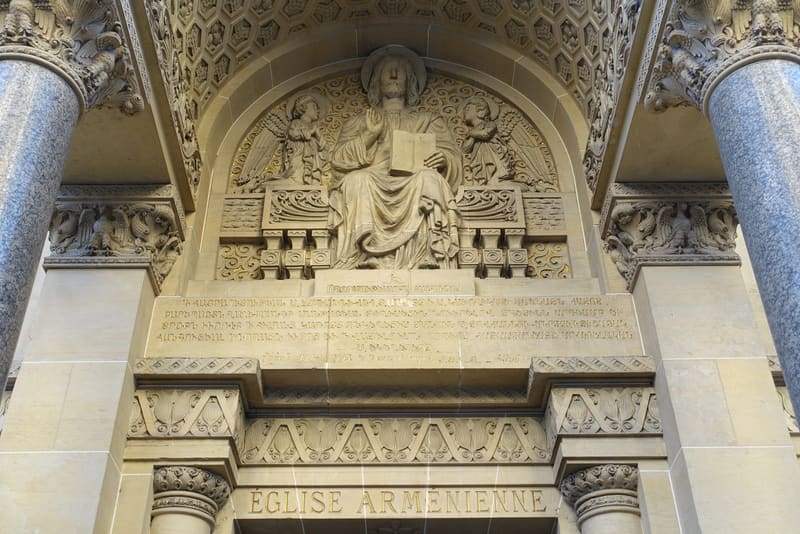
The oldest is the Cathedral of Saint John the Baptist in Paris, on rue Jean-Goujon, built in 1902–1904 thanks to the patron Alexander Mantashev. The refugees then built their own churches: in Marseille (1928 and 1931), Nice (1928), Alfortville (1930), then Lyon (1963), Issy-les-Moulineaux (1975) and Valence (1992).
The Diocese of France of the Armenian Apostolic Church was created in 2006. There are also Armenian Catholic and Evangelical communities.
Remembering the genocide
The Décines memorial near Lyon, inaugurated in 1972, is the first public monument in France dedicated to the Armenian genocide.
The law of 29 January 2001 states that “France publicly recognises the Armenian genocide of 1915”. Since a decree of 10 April 2019, 24 April has been the national day of remembrance of the Armenian genocide.
On 21 February 2024, Missak Manouchian, an Armenian Resistance fighter shot by the Nazis in 1944, and his wife Mélinée were laid to rest in the Panthéon.
Landmarks
- The Armenian Students’ House at the Cité internationale universitaire de Paris, inaugurated in 1930 thanks to a donation from Boghos Nubar.
- The Armenian Heritage Centre in Valence, devoted to the history and memory of Armenians.
- The Décines memorial and rue du 24-Avril-1915, named in 1965.
City by city
History, landmarks and news of Armenians in seven French cities:
Sources
- Diocèse de l’Église apostolique arménienne de France
- Camp Oddo — Wikipédia
- Passeport Nansen — Wikipédia
- Loi n° 2001-70 du 29 janvier 2001 relative à la reconnaissance du génocide arménien (Légifrance)
- Décret du 10 avril 2019 portant création d’une journée nationale de commémoration du génocide arménien (Légifrance)
- Maison des étudiants arméniens — Cité internationale universitaire de Paris