Armenia-Azerbaijan peace agreement: what it says and where it stands
The text of the Armenia-Azerbaijan peace treaty has been ready since March 2025 and was initialled in Washington in August 2025. Yet it has been neither signed nor ratified. Here is what it contains, what it would change and what is still holding it up.
- Published
- Facts as of
The essentials
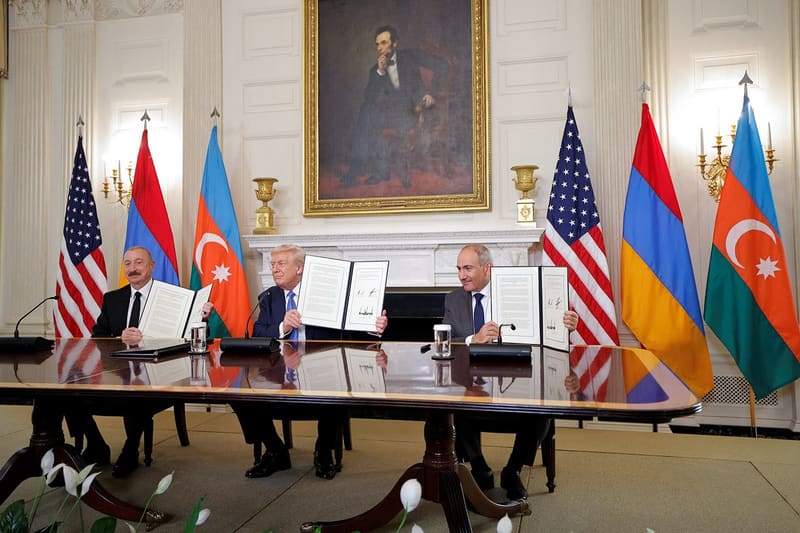
On 8 August 2025, at the White House, Armenian Foreign Minister Ararat Mirzoyan and his Azerbaijani counterpart Jeyhun Bayramov initialled the “Agreement on Establishment of Peace and Inter-State Relations”. Initialling a treaty means approving its final text: it is not yet a signature.
To take effect, the agreement still has to be signed and then ratified by both countries. As of 1 November 2026, neither step has happened. Azerbaijan says it will not sign until Armenia changes its constitution.
Key dates
- 1992The OSCE Minsk Group is created to negotiate a settlement of the Nagorno-Karabakh conflict. From 1997 it is co-chaired by France, Russia and the United States.
- September 2023After a lightning Azerbaijani offensive, almost all of Nagorno-Karabakh’s Armenians, more than 100,000 people, flee to Armenia.
- 30 August 2024The Armenian and Azerbaijani border commissions sign their joint working rules, which take effect on 1 November 2024.
- 13 March 2025Talks on the text end: Armenia accepts Baku’s proposals on the last two disputed articles. The same day, Azerbaijan restates its condition that Armenia change its constitution.
- 8 August 2025In Washington, the two foreign ministers initial the agreement. Ilham Aliyev and Nikol Pashinyan sign a joint declaration witnessed by Donald Trump, which also launches the “Trump Route” (TRIPP) project across southern Armenia.
- 11 August 2025Both countries publish the full text of the agreement.
- 1 September 2025At the joint request of Yerevan and Baku, the OSCE decides to close the Minsk process. The closure is completed on 30 November 2025.
- 7 June 2026Armenian parliamentary election: Nikol Pashinyan’s Civil Contract keeps its majority with 64 of 105 seats, but not the two-thirds (70 seats) needed to put a new constitution to a referendum on its own.
- 28 October 2026Armenia’s parliament ratifies the framework agreement with the United States on the Trump Route by 63 votes to 32.
What the text says
The agreement is short: a preamble and 17 articles. The main commitments:
- Each country recognises the other’s sovereignty and territorial integrity within the borders inherited from the former Soviet republics (Article 1).
- Neither has any territorial claim on the other, and neither will raise one in the future (Article 2).
- They renounce the use or threat of force and will not let a third country use their territory to attack the other (Article 3). They will not interfere in each other’s internal affairs (Article 4).
- Diplomatic relations will be established after ratification. The deadline is left blank in the text (Article 5).
- The border commissions continue drawing the common border (Article 6).
- Neither country will deploy forces of a third country along that border (Article 7).
- They undertake to establish the fate of people who went missing during the conflict and to search for and return remains (Article 9).
- A bilateral commission will oversee implementation. In a dispute, six months of direct consultations come before any other peaceful means (Articles 13 and 14).
- Within a month of entry into force, both countries withdraw all their claims against each other before international courts. They also refrain from any hostile action, including in the information field (Article 15).
- The agreement is drafted in Armenian, Azerbaijani and English. If the versions differ, the English text prevails (Article 17).
What the deal would change
It would be the first treaty setting out relations between the two countries since independence in 1991. It would pave the way for embassies and for a border recognised in writing by both sides.
The cases the two states have brought against each other, notably at the International Court of Justice, would have to be dropped. The ban on foreign forces along the border would also shift the regional balance: according to Reuters, the clause may refer to Russia, which has deployed peacekeepers in the region.
Finally, the Washington declaration provides for opening transport links, including a route between Azerbaijan and its Nakhchivan exclave across Armenia’s Syunik province, with “reciprocal benefits” for Armenia. This is the Trump Route project, which Armenia says will remain under its sovereignty and control, including customs and border security.
Questions still open
- The constitution. Baku wants Armenia’s constitution to stop referring to the 1990 Declaration of Independence, which mentions reunification with Nagorno-Karabakh. Yerevan denies that its constitution contains territorial claims, but is preparing a new one. Holding the required referendum needs approval by two-thirds of parliament, which the ruling majority no longer has. The draft has not yet been published.
- The timetable. On 28 October 2026, Ararat Mirzoyan said Armenia was ready to sign as early as the end of 2026. On 22 October, Nikol Pashinyan spoke of 2027–2028.
- The Trump Route. Security arrangements and the construction timetable have not been set. Armenia’s opposition argues that the benefits promised to Armenia are not legally guaranteed, and neighbouring Iran has voiced concern.
- What the text leaves out. The agreement does not mention Nagorno-Karabakh, the Armenians displaced from it, or the Armenians held in Azerbaijan. Only missing persons have an article of their own.