The Armenian Genocide: what you need to know
During the First World War, the Ottoman government organised the destruction of the Empire’s Armenian population. More than a century later, recognition of this genocide is still a diplomatic issue. The facts, figures and dates to know.
- Published
- Facts as of
The essentials
The Armenian Genocide refers to the extermination of the Ottoman Empire’s Armenians, carried out mainly in 1915 and 1916 by the government of the Committee of Union and Progress, the “Young Turks” party. Armenians call it Medz Yeghern, “the great crime”.
About 1.5 million Armenians lived in the Empire in 1915. The exact death toll is unknown: the United States Holocaust Memorial Museum (USHMM) puts it at at least 664,000 and possibly as many as 1.2 million. Armenians and many historians use the figure of 1.5 million victims.
What happened
The violence did not begin in 1915: at least 80,000 Armenians were killed in the massacres of 1894–1896, and up to 20,000 in Adana in 1909, according to the USHMM.
The Ottoman Empire entered the war in November 1914 on Germany’s side. On 24 April 1915, in Constantinople, the authorities arrested some 240 to 250 Armenian community leaders (intellectuals, politicians, clergy, merchants), who were then deported. This round-up is regarded as the start of the genocide.
From May 1915, a deportation law drove Armenians out of their towns and villages, first in eastern Anatolia and then across almost the entire Empire. Men were often killed on the spot. Women, children and the elderly were marched towards the deserts of present-day Syria and Iraq. Many died on the way from hunger, thirst, exhaustion or disease, or were murdered. Tens of thousands of children were taken from their families and forcibly converted. The deportees’ property was confiscated. Other Christians in the Empire, notably Assyrians, were also targeted.
Why is it called a genocide?
The word “genocide” was coined in 1944 by the lawyer Raphael Lemkin, who said the fate of the Armenians had led him to think about legal protection for peoples. In 1948 the UN adopted the Convention on the Prevention and Punishment of the Crime of Genocide.
Most historians consider that the killings of 1915–1916 meet this definition: Ottoman, German, Austrian, American, British and French documents of the time show that the ruling party’s leadership deliberately targeted the Armenian population. Turkey, the Ottoman Empire’s successor, rejects the term genocide: it acknowledges that Armenians died during the deportations but describes these deaths as tragedies of war.
Who recognises it?
- Uruguay was the first country to recognise it, in 1965.
- The European Parliament recognised it in 1987 and has since repeatedly called on Turkey to do the same.
- Germany’s Bundestag adopted a resolution on 2 June 2016, also acknowledging Germany’s share of responsibility as the Ottoman Empire’s ally.
- In the United States, President Joe Biden formally recognised it on 24 April 2021.
- In all, some thirty countries have officially recognised it, including France, Italy, Russia, Canada, Brazil and Argentina. In 2015, for the centenary, Pope Francis called it “the first genocide of the 20th century”.
France: the 2001 law
Law no. 2001-70 of 29 January 2001 has a single article: “France publicly recognises the Armenian genocide of 1915.”
In 2012, parliament passed a law making it an offence to deny genocides recognised by law, including the Armenian Genocide. The Constitutional Council struck it down on 28 February 2012, ruling that it infringed freedom of expression.
Since a decree of 10 April 2019, 24 April has been France’s annual day of commemoration of the Armenian Genocide. A ceremony is held in Paris every year, and prefects may organise ceremonies in each département.
24 April, a day of remembrance
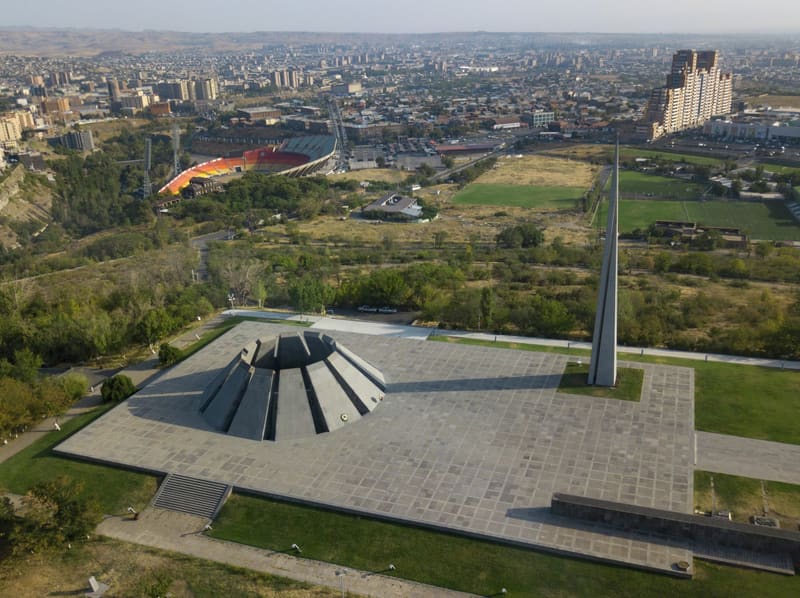
Every 24 April, huge crowds in Yerevan walk up to Tsitsernakaberd, the genocide memorial built in 1967 on a hill in the capital, to lay flowers around the eternal flame. A museum-institute has been open there since 1995.
Across the diaspora, from France and the United States to Lebanon and Russia, marches, church services and official ceremonies take place on the same day.