Armenian food: the essential dishes
Bread baked against the wall of a clay oven, stuffed vine leaves, skewers grilled over embers, a winter soup eaten at dawn: these are the basics of Armenian cuisine, plus what to know about the country’s wine and brandy.
- Published
- Facts as of
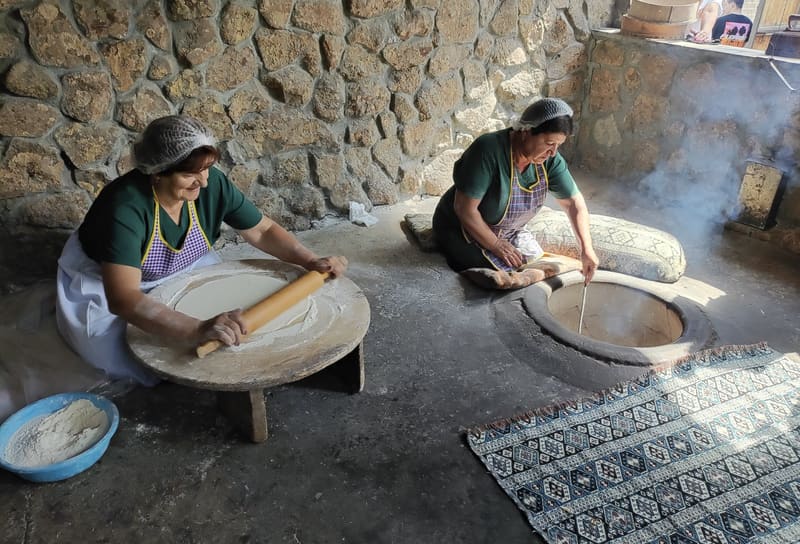
Lavash, a bread on UNESCO’s heritage list
Lavash is a very thin bread made from flour and water. According to UNESCO, small groups of women roll it out and slap it against the wall of a conical clay oven, the tonir, where it bakes in 30 to 60 seconds.
Once dried, it keeps for up to six months. It comes with most meals and also plays a part in rituals: at weddings it is laid on the shoulders of the newlyweds.
In 2014 UNESCO added the making and meaning of lavash in Armenia to its list of intangible cultural heritage. Neighbouring peoples have the same bread, and the listing does not mean it belongs to Armenia alone.
Tolma, stuffed vine leaves
Tolma is a filling of minced meat, rice and herbs rolled in vine leaves. Other versions use cabbage leaves or vegetables such as aubergines, peppers and tomatoes.
During Lent, people make a meatless tolma, pasuts tolma, filled with pulses such as beans or lentils. A festival devoted to tolma is held every year in Armenia.
Khorovats, the barbecue for special days
Khorovats is Armenian barbecue: pieces of meat, most often pork but also lamb, threaded onto long skewers and cooked over the embers of a mangal, a grill without a grate.
Aubergines, tomatoes and peppers are grilled too. Khorovats is the dish for celebrations and gatherings of friends; a khorovats festival is held every year in Akhtala, in Lori province.
Khash, the soup for winter mornings
Khash is a broth of cow’s feet simmered for many hours. It is eaten in winter, early in the morning, with friends, with crushed garlic, salt and dried lavash crumbled into the broth.
It is a social meal with toasts, often described as a cure for the morning after.
Ghapama, the festive stuffed pumpkin
Ghapama is a hollowed-out pumpkin filled with rice, dried fruit (apricots, raisins, prunes), nuts and honey, then baked.
It is served in autumn to celebrate the harvest, and at major celebrations: New Year, Christmas, Easter and weddings. There is even a popular song about it, “Hey jan ghapama”.
Gata, the sweet bread
Gata is a sweet bread, often round, filled with khoriz, a mixture of flour, butter and sugar. There are many regional versions.
It is linked to Geghard Monastery, near Yerevan, where decorated gatas are sold to visitors.
Wine and brandy
In the Areni-1 cave, in Vayots Dzor province, archaeologists uncovered a winemaking installation, announced in 2011 and dated to around 4100–4000 BC, the oldest known so far. The village of Areni holds a wine festival every autumn.
Armenian brandy began in 1887, when the merchant Nerses Tairyan opened a distillery in Yerevan. That company, the Yerevan Brandy Company, makes the ARARAT brand; it has belonged to the French group Pernod Ricard since 1999.
Read more
News about Armenian restaurants, produce and chefs, in Armenia and the diaspora:
Sources
- UNESCO — Le lavash, préparation, signification et aspect du pain traditionnel en Arménie (2014)
- Smithsonian Folklife Festival — Khorovats, Armenia’s favorite grilling pastime
- Smithsonian Magazine — A brief history of khash
- Smithsonian Folklife Festival — Ghapama (stuffed pumpkin)
- MyArmenia (Smithsonian / USAID) — Tolma Festival
- National Geographic — Earliest known winery found in Armenian cave
- Jamestown Foundation — Pernod Ricard acquires famed Yerevan Brandy Company
- Wikipedia — Armenian cuisine