The Armenian alphabet and language: the essentials
Armenian has been written in its own alphabet since the early 5th century. It forms a branch of the Indo-European family on its own and exists today in two forms: Eastern, spoken in Armenia, and Western, the language of the diaspora. Here are the essentials.
- Published
- Facts as of
The essentials
Armenian is an Indo-European language, like French, Greek or Persian. But it belongs to no subgroup: it forms a branch of that large family on its own.
It is the official language of the Republic of Armenia. It is also spoken throughout the diaspora, from Russia to the United States, France, Lebanon and Syria.
It is written in its own alphabet, created around 405 AD and still in use today.
An alphabet created around 405
According to tradition, the Armenian alphabet was created around 405 by the monk Mesrop Mashtots, with the support of Catholicos Sahak Partev, head of the Armenian Church. Armenia had become Christian in the early 4th century, but the Bible and the liturgy were read in Greek or Syriac. The people’s language needed a script.
Also according to tradition, the first sentence written in Armenian comes from the Book of Proverbs: “To know wisdom and instruction, to perceive the words of understanding.” Mashtots and his disciples then translated the Bible.
The alphabet first had 36 letters. Two letters, “օ” (o) and “ֆ” (f), were added in the Middle Ages to render foreign sounds, bringing the total to 38. The letters were also used as numerals: they can still be seen in the dates on churches and manuscripts.
In 2019, UNESCO inscribed Armenian letter art and its cultural expressions on its list of the Intangible Cultural Heritage of Humanity.
From Classical Armenian to today’s languages
The language of the first texts is called Grabar, or Classical Armenian. It remained the literary language until the 19th century and is still the liturgical language of the Armenian Apostolic Church.
In the 19th century, two modern written languages took shape. Eastern Armenian developed around Yerevan and Tiflis (today’s Tbilisi), in the Russian Empire. Western Armenian developed around Constantinople, in the Ottoman Empire.
Eastern and Western Armenian
Eastern Armenian is the language of Armenia and of Iran’s Armenians. Western Armenian is spoken by the descendants of the Ottoman Empire’s Armenians, scattered after the 1915 genocide: notably in Lebanon, Syria, France, the United States and among Istanbul’s Armenians.
The two forms are largely mutually intelligible, but several consonants are pronounced differently. That is why the same first name is spelt Grigor or Krikor, Vardan or Vartan, depending on the family.
In 2010, UNESCO listed Western Armenian as “definitely endangered” in its atlas of the world’s languages in danger. Diaspora schools, newspapers and associations work to pass it on.
Two spelling systems
Between 1922 and 1924, Soviet Armenia adopted a reformed spelling, still used in Armenia. Iran’s Armenians and all Western Armenian speakers kept the traditional, so-called classical spelling.
The difference shows in the very name of the capital: Երևան in reformed spelling, Երեւան in classical spelling. Barev World publishes in Western Armenian, in classical spelling.
Learning Armenian in France
In France, Armenian schools, community classes and parishes teach the language. Armenian can also be taken as a modern language in the baccalauréat, provided the student has followed the corresponding course.
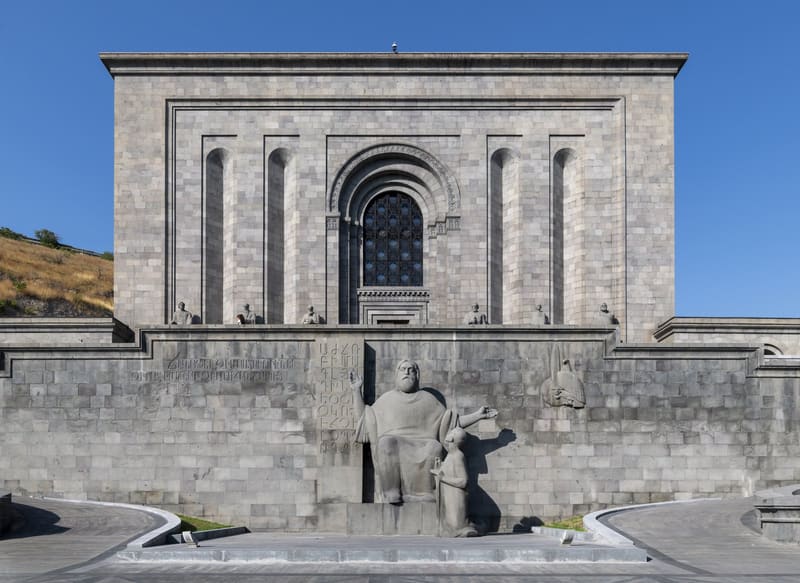
Yerevan’s Matenadaran, the institute of ancient manuscripts named after Mesrop Mashtots, holds one of the world’s largest collections of manuscripts. Its statue of Mashtots, in front of the entrance, is one of the city’s symbols.
From manuscripts to print
Yerevan’s Matenadaran holds one of the world’s richest collections of Armenian manuscripts. It has been on UNESCO’s Memory of the World Register since 1997.
The first book printed in Armenian, the Urbatagirk (“Book of Fridays”), came off the presses in Venice in 1512, the work of Hakob Meghapart. Venice remained a major centre of Armenian books, notably through the Mekhitarist congregation, based on the island of San Lazzaro since 1717.
To mark 500 years of Armenian printing, UNESCO made Yerevan World Book Capital in 2012.
Further reading
Our explainers and stories about the Armenian language:
- Armenian first names: origins and meanings
- Yerevan: a guide to Armenia’s capital
- Ruben Rubinyan: under the new Constitution, Armenian would remain the sole state language, with no possibility of amendment
- Glendale: applications open for the first public Western Armenian immersion programme
- At UNESCO in Paris, the Hover choir closes a tribute to Hrachia Acharian and Yerevan’s Republic Square
- Ferdowsi’s “Book of Kings” in Armenian prose: tribute to Loris Tjeknavorian at Yerevan’s Blue Mosque
Frequently asked questions
Who created the Armenian alphabet?
According to tradition, the monk Mesrop Mashtots, around 405, with the support of Catholicos Sahak Partev. The alphabet then had 36 letters; two were added in the Middle Ages, bringing the total to 38.
How many letters are in the Armenian alphabet?
38 letters: the 36 created around 405, plus “օ” (o) and “ֆ” (f), added in the Middle Ages.
What is the difference between Eastern and Western Armenian?
Eastern Armenian is the language of Armenia and of Iran’s Armenians; Western Armenian is that of the diaspora descended from the Ottoman Empire (Lebanon, Syria, France, the United States…). They are largely mutually intelligible, but some consonants are pronounced differently, and Western Armenian keeps the classical spelling.
Is Western Armenian endangered?
Yes. In 2010, UNESCO listed it as “definitely endangered” in its atlas of the world’s languages in danger.