Yerevan: a guide to Armenia’s capital
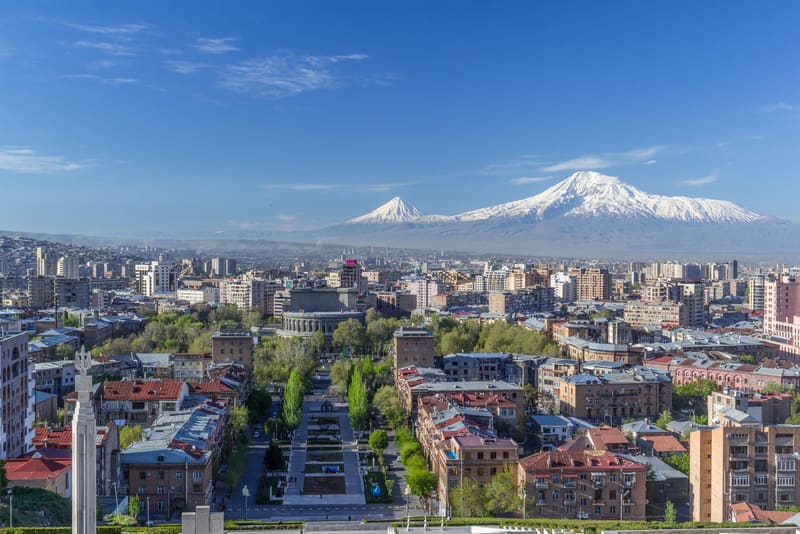
Yerevan has been Armenia’s capital since 1918, but the city is far older: its Erebuni fortress dates from 782 BC. More than a million people, pink stone buildings, Mount Ararat in the background: here is what you need to know to understand and visit the capital.
- Published
- Facts as of
The essentials
Yerevan has more than a million inhabitants, over a third of Armenia’s population. It is the country’s political, economic and cultural centre. The city stretches along the Hrazdan river, at the edge of the Ararat Plain.
On a clear day, Mount Ararat and its two snow-capped peaks can be seen from almost anywhere in the city. The mountain, a national symbol for Armenians, lies across the border, in Turkey.
Yerevan is divided into twelve administrative districts. The centre is easy to explore on foot, around Republic Square and the Opera.
From the Erebuni fortress to the modern city
In 782 BC, King Argishti I of Urartu had the Erebuni fortress built on a hill in the south-east of today’s city. This is Yerevan’s founding date, making it one of the oldest continuously inhabited cities.
Yerevan became the capital of the first Republic of Armenia in 1918, then of Soviet Armenia. In 1924, the authorities approved the general plan of the architect Alexander Tamanian. He designed a city of rings around a centre, built of tuff, a volcanic stone in shades of pink and ochre. Hence its nickname, the “pink city”.
In 1988, the huge rallies of the Karabakh movement took place on Theatre Square, now Freedom Square, next to the Opera. Yerevan became the capital of independent Armenia in 1991.
What to see
- Republic Square, the heart of the city, designed by Tamanian and lined with official buildings in tuff.
- The Cascade, a giant stairway climbing to the north of the city. It houses the Cafesjian Center for the Arts, and its top offers one of the best views of Yerevan and Ararat.
- The Opera, another Tamanian building, set in a large park.
- The Matenadaran, the institute of ancient manuscripts, which holds one of the world’s largest collections of manuscripts. A statue of Mesrop Mashtots, creator of the Armenian alphabet, stands at its entrance.
- Tsitsernakaberd, the Armenian Genocide memorial, built on a hill in 1967, and its museum.
- The Erebuni fortress and its museum, where the city was born.
- Saint Gregory the Illuminator Cathedral, the largest Armenian church in the world, consecrated in 2001 for the 1,700th anniversary of Christianity in Armenia.
- The Blue Mosque, built in the 18th century, the only active mosque in the country.
- The Vernissage, an open-air market that began in the late 1980s, selling rugs, woodcarvings and handicrafts.
Getting there and around
Zvartnots International Airport, the country’s main airport, lies about fifteen kilometres west of Yerevan.
The Yerevan Metro opened on 7 March 1981. It has a single line, 13.4 km long, with ten stations. Buses, minibuses and taxis complete the network. The city is preparing to buy 170 electric buses.
Armenia stays on UTC+4 all year round: Yerevan is three hours ahead of Paris in winter and two hours ahead in summer.
Climate: scorching summers, cold winters
Yerevan has a dry continental climate. Summers are hot and sunny, with peaks that sometimes exceed 40°C. Winters are cold, with snow and frost. There is little rain all year.
Spring and autumn are the mildest seasons for exploring the city and its surroundings on foot.
Around Yerevan
Several major sites can be visited in a day from the capital. To the west, the town of Etchmiadzin is home to the mother cathedral of the Armenian Apostolic Church, first built in the early 4th century. Together with the nearby ruins of Zvartnots Cathedral, it has been a UNESCO World Heritage site since 2000.
To the east lie the ancient temple of Garni, about thirty kilometres away, and Geghard monastery, partly carved into the rock and a World Heritage site since 2000. To the south, Khor Virap monastery faces Mount Ararat.
A city that hosts
UNESCO named Yerevan World Book Capital for 2012. The year marked 500 years of Armenian printing: the first book in Armenian was printed in Venice in 1512.
The city also hosts major international conferences. In October 2026 it welcomed COP17, the UN biodiversity conference, which closed on 31 October with nearly 200 countries adopting its key texts.
Practical matters
- Currency: the Armenian dram (AMD).
- Official language: Armenian, written in its own alphabet.
- Time: UTC+4 all year round, 3 hours ahead of Paris in winter and 2 hours in summer.
- Emergencies: 112 or 911; entry and safety rules are covered in our guide to travelling to Armenia.
Further reading
Our guides and Yerevan news:
- Travelling to Armenia: entry rules, time, money, safety
- Armenian food: the essential dishes
- The Armenian Genocide: what you need to know
- Yerevan prepares to buy 170 electric buses and rules out banning drivers from the regions
- Tourism: over 2 million visits to Armenia from January to October 2026, October up 34%
- The 18th ReA animation and comics festival opens in Yerevan
Frequently asked questions
How old is Yerevan?
The city was born with the Erebuni fortress, founded in 782 BC by King Argishti I. Yerevan has been Armenia’s capital since 1918.
How many people live in Yerevan?
More than a million, over a third of Armenia’s population.
Can you see Mount Ararat from Yerevan?
Yes, on a clear day, from almost anywhere in the city. The mountain lies across the border, in Turkey. The Cascade offers one of the best views.
What is the time difference between Paris and Yerevan?
Yerevan is three hours ahead of Paris in winter and two hours ahead in summer: Armenia stays on UTC+4 all year round.