Karekin II: head of India’s Malankara Orthodox Church offers support and regrets being unable to meet him
- Published
- Place
- Moscow, Russia
- Event date
- Past event —
Summary
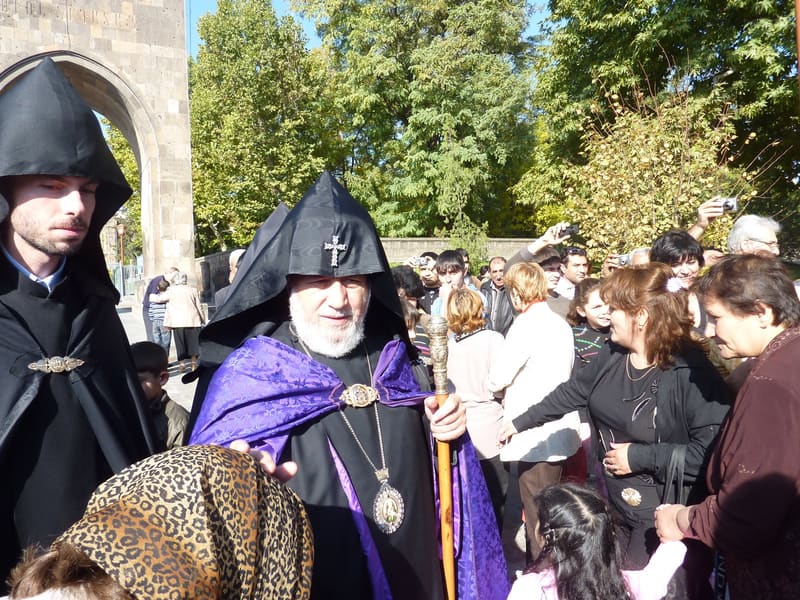
The head of the Malankara Orthodox Syrian Church in India has expressed support for the Catholicos of All Armenians, Karekin II. Baselios Marthoma Mathews III did so in Moscow, where he is attending celebrations for Patriarch Kirill’s 80th birthday. Received at the Armenian church complex in the Russian capital by Archbishop Yezras Nersisyan, he regretted being unable to meet Karekin II, who is barred from leaving Armenia. According to the Armenian site 301.am, he called those restrictions unjustified. He said he hoped to meet the Catholicos in person one day. Karekin II has been prosecuted since February for obstructing the enforcement of a court decision, and Nikol Pashinyan’s government is calling for him to step down.
The visit took place on Saturday 22 November, on the sidelines of the celebrations for the Moscow Patriarch’s birthday. The Malankara delegation was welcomed by Archbishop Yezras Nersisyan, who heads the Armenian Apostolic Church’s Diocese of Russia and New Nakhichevan. A joint prayer was held in the Armenian Cathedral of the Transfiguration, after which the visitors toured the complex’s “Tapan” museum.
According to Sputnik Armenia, Mathews III said he was concerned about the situation. He stressed the long-standing ties between the two Churches, rooted in a shared faith and centuries of brotherhood.
A sister Church from India
The Malankara Orthodox Syrian Church is headquartered in Kottayam, in the southern Indian state of Kerala. It traces its origins to the preaching of the Apostle Thomas in the first century and reports around 2.5 million faithful. Baselios Marthoma Mathews III has led it since October 2021, with the title of Catholicos of the East.
Like the Armenian Church, it belongs to the family of Oriental Orthodox Churches, alongside the Coptic, Syriac, Ethiopian and Eritrean Churches. These Churches recognise only the first three Ecumenical Councils and are in full communion with one another. Support from one of them therefore carries particular weight for Etchmiadzin.
A Catholicos who can no longer travel
Karekin II was charged on 14 February 2026 with obstructing the enforcement of a judicial act, along with six bishops on the Supreme Spiritual Council. The case concerns former bishop Gevorg Saroyan, removed as head of the Masyatsotn diocese in January after backing Nikol Pashinyan’s calls for a change of Church leadership. A court had ordered his reinstatement, which the Church refused. The case was sent to the Armavir Region court of first instance this summer.
Since being charged, the Catholicos has been barred from leaving the country. He was unable to travel to Georgia on 22 March for the funeral of Patriarch Ilia II. According to the NGO Forum 18, a court lifted the ban in April before it was reinstated.
Political pressure continues. The government’s 2026–2031 programme provides for Karekin II’s departure, and Parliament Speaker Ruben Rubinyan again called on him on 17 November to leave the patriarchal throne.
Analysis
Mathews III’s gesture is first of all symbolic, but it comes as the Armenian government openly demands the Catholicos’ departure. The support comes not from a Western Church or the diaspora, but from a sister Church of the same Oriental Orthodox family. The venue matters too: Moscow, where Patriarch Kirill was gathering Church leaders. For the Armenian government, which accuses part of the clergy of being close to Russia, the setting is awkward. For Etchmiadzin, it is proof that the travel ban carries a visible diplomatic cost.
Possible consequences
Karekin II remains barred from leaving the country for as long as the criminal proceedings against him in Armavir continue.