Armenian economy: 5.8% growth in the third quarter of 2026, driven by construction and digital services
- Published
- Place
- Yerevan, Armenia
- Event date
- Past event —
Summary
Armenia’s gross domestic product grew by 5.8% in real terms in the third quarter of 2026, compared with the same period of 2025. The Statistical Committee (Armstat) announced it on Friday 20 November in its preliminary data. GDP reached 3,379.8 billion drams at current prices, against 3,071.7 billion a year earlier. Growth slowed after a second quarter at 6.7%, but remains above the first (5.2%). Construction (+20.2%), accommodation and food services (+20.9%) and information and communication (+18.7%) are driving activity. Manufacturing fell by 2% and energy by 12.4%. GDP per capita rose to 1,087,578 drams for the quarter.
Over the first nine months of 2026, the Armenian economy produced around 8,547 billion drams of output, according to Armstat’s three quarterly estimates. The third quarter alone accounts for nearly 40% of that total: it is traditionally the season for harvests, building work and tourism.
Real growth, which strips out price effects, reached 5.2% in the first quarter, 6.7% in the second and 5.8% in the third. The figure is preliminary and may still be revised.
The sectors driving growth
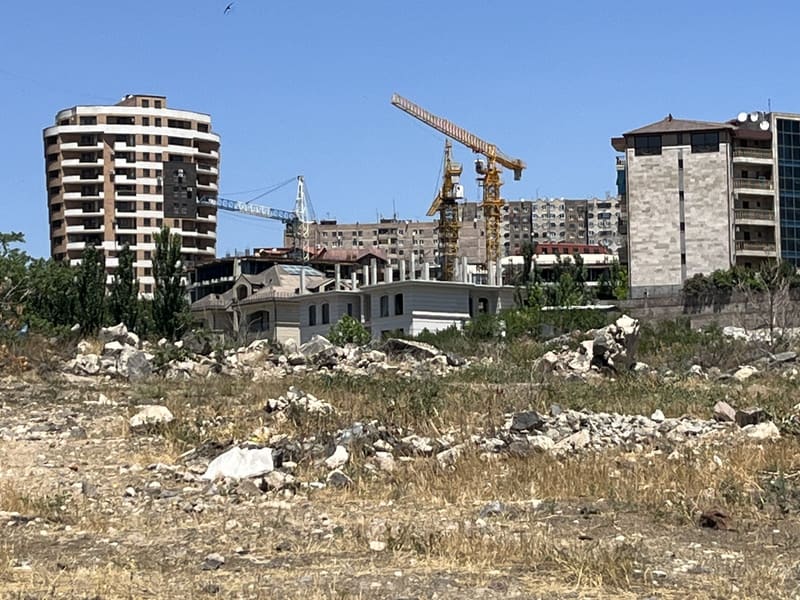
Construction is the most visible engine. It grew 20.2% year on year and now accounts for 7.9% of GDP in the third quarter, up from 5.4% in the second. Accommodation and food services jumped 20.9%, in line with rising tourist numbers.
Information and communication, which includes much of the IT sector, gained 18.7%. Transport and storage rose 11.6%, mining 9.9% and financial activities 5.3%.
Trade, the largest sector at 13.1% of GDP, was almost flat (+0.6%). Agriculture, worth 8.7% of third-quarter output, grew only 0.3%.
The weak spots
Two sectors fell sharply. Manufacturing lost 2% year on year. Electricity and gas supply dropped 12.4%. Arts and recreation fell 7.9%.
September indicators, released the same day, complete the picture. The economic activity indicator stood at 105.0%. Foreign trade for the month reached $1,644.1 million: $543 million of exports against $1,101.1 million of imports. The average nominal wage was 308,927 drams.
Analysis
The Armenian economy is keeping up a strong pace, but its growth engine is changing. After the years of re-exports to Russia, building sites, tourism and digital services are now carrying activity. These sectors are geared towards the domestic market and services, and are more sensitive to the economic cycle and to credit. The decline in manufacturing and energy shows that the productive base remains fragile, while the government is betting on power-hungry artificial intelligence factories.
Possible consequences
Armstat will publish final third-quarter figures in the coming months. The estimate of full-year 2026 growth is expected in early 2027.