Demining: the European Union gives Armenia a second remote-controlled machine
- Published
- Place
- Armenia
- Event date
- Past event —
Summary
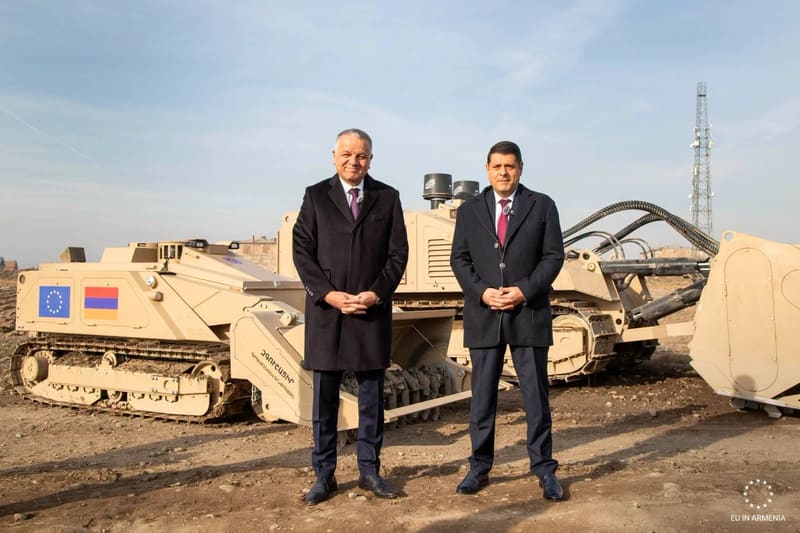
Armenia now has a second demining machine donated by the European Union. EU Ambassador to Yerevan Vassilis Maragos and Eduard Petrosyan, director of the Center for Humanitarian Demining and Expertise, presented it on Friday, 13 November. It is an MV-4, a smaller model than the MV-10 delivered in July. Like the MV-10, it is operated by remote control, so deminers can clear dangerous ground from a safe distance. The EU is also funding training for Armenian deminers on these machines and part of the centre’s operating costs. The aim, according to the EU delegation, is to work faster and more safely, so that people in border villages can get on with normal life. According to the United Nations Development Programme (UNDP), more than 43 square kilometres are still contaminated by mines and unexploded ordnance.
Slow and dangerous work
“Clearing mines is slow and dangerous work,” the EU delegation notes on its Facebook page. Remote-controlled machines change that. The deminer stays at a distance while the machine churns the ground and sets off the charges. The risk of injury drops sharply.
The MV-4 is more compact than the MV-10. It can therefore work on narrower or harder-to-reach ground. Both machines have been handed to the Center for Humanitarian Demining and Expertise, the state body in charge of clearing contaminated areas.
The second machine arrives four months after the first. The aid goes beyond equipment: without trained deminers to operate them and a budget to run them, these machines would stay in the garage. That is why the EU is also paying for training and part of the centre’s costs.
More than 230,000 people at risk
UNDP figures, cited by Azatutyun, show the scale of the task. More than 43 square kilometres of Armenian land are still contaminated. More than 230,000 people live under the threat, mostly in villages near the border.
For these residents, a mine is not an abstraction. It stops them farming a field, grazing a herd or building. Cleared land can be returned to agriculture and to families.
Before the new border crossings
Demining is also a precondition for European projects. In July, Vassilis Maragos said that building three new border crossing points planned by the EU in Armenia would have to be preceded by demining work, according to Azatutyun.
This work comes amid talks on opening regional routes between Armenia and its neighbours. Mined areas remain a very concrete obstacle to any transport or trade project.
Analysis
Two machines will not clear 43 square kilometres. But the European aid is well aimed: machines, trained deminers and money for running costs, where Armenia lacks resources. Demining is a low-profile issue, far from the big summits. Yet it directly affects the lives of hundreds of thousands of people. It also shapes the opening of borders that is so often discussed. Every plot made safe is a small step towards safer border regions. What matters now is how fast the ground is actually cleared.
Possible consequences
Armenian deminers are to be trained to operate the MV-4. No timetable for operations has been given.