Yerevan traffic jams: Mayor Tigran Avinyan blames the rise in cars, not construction
- Published
- Place
- Yerevan, Armenia
- Event date
- Past event —
Summary
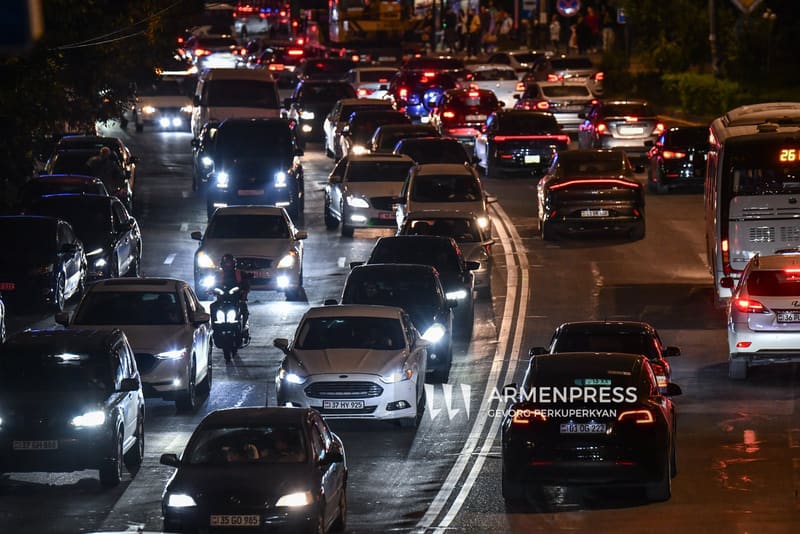
Why is Yerevan so congested? For Mayor Tigran Avinyan, the main cause is the “exponential” rise in the number of cars, not new buildings. He said so on Monday 16 November at City Hall’s staff meeting. His answer targeted criticism from the municipal opposition, but also from Anna Hakobyan, the wife of Prime Minister Nikol Pashinyan. In a video filmed in a car, she had said that getting around the capital required “an astronaut’s health”. The mayor offered his figures: about 530,000 validations a day on public transport, metro included, 60 to 70% more than ten years ago. He defended construction, which funds courtyards, roads and football pitches. And he warned that restrictions on cars will be needed, even if they prove unpopular.
Everyone agrees on the diagnosis: at rush hour, the Armenian capital, home to more than a million people, grinds to a halt. What divides people is who is to blame.
Tigran Avinyan set out to answer point by point. “Various arguments are circulating about traffic in Yerevan. If we do not address them, others will, people who seemingly do not understand the systemic problem,” he said.
“People are not born in buildings”
According to the mayor, the economy is growing, jobs and incomes are rising, and residents are buying cars. “The number of cars in Yerevan has increased at an exponential rate, for one simple reason: Armenia’s economy is growing,” he said.
He rejects the idea that new buildings worsen traffic. Many buyers move from an old flat to a new one with underground parking, bringing the car they already owned. “People are not automatically born in buildings,” he summed up. In his view, the population has grown mainly with the arrival of families displaced from Nagorno-Karabakh and of people who came because of the Russia-Ukraine war.
Official data also put the boom in perspective: 87 building permits for residential blocks in 2023, 85 in 2024, 31 in 2025 and 20 in the first eight months of 2026.
Slowing construction would push up purchase and rental prices, the mayor warned, mentioning levels comparable to Miami. Since 2022, fees on construction have funded hundreds of courtyards, roads, football pitches, kindergartens and pavements.
Neighbourhood schools and old cars in the spotlight
The mayor admits the situation is getting worse. “Public transport works poorly because there are too many private cars. At rush hour, our buses cannot reach the stops,” he said. The metro, for its part, has grown from 12 to 23 million passengers a year since 2016.
He also targets school runs: too many parents enrol their children far from home. “Your child should go to school where they can walk,” he insisted. He says old cars should be restricted in the city and criticises some drivers’ lack of discipline. “I will push the solutions through with a bulldozer,” he warned, anticipating opposition protests against future restrictions.
Finally, he called for jobs to be created in the regions to reduce trips into the capital.
Analysis
The debate goes beyond engineering. When the Prime Minister’s wife publicly criticises how the capital is run, the issue becomes political. Each side has a point: permits have fallen sharply since 2023, but new districts concentrate traffic. Tigran Avinyan’s line is clear: fewer cars, more public transport, neighbourhood schools. The question is which restrictions he will propose, and when. The metro, whose ridership has almost doubled, shows that an alternative attracts people when it exists. Residents interviewed mostly call for a wider network.
Possible consequences
The mayor wants to put his ideas to public debate: restrictions on cars, limits on old vehicles, neighbourhood schooling. No specific measure or timetable has been announced yet.