Johann Wadephul in Yerevan: Berlin backs peace with Baku and closer EU ties
- Published
- Place
- Yerevan, Armenia
- Event date
- Past event —
Summary
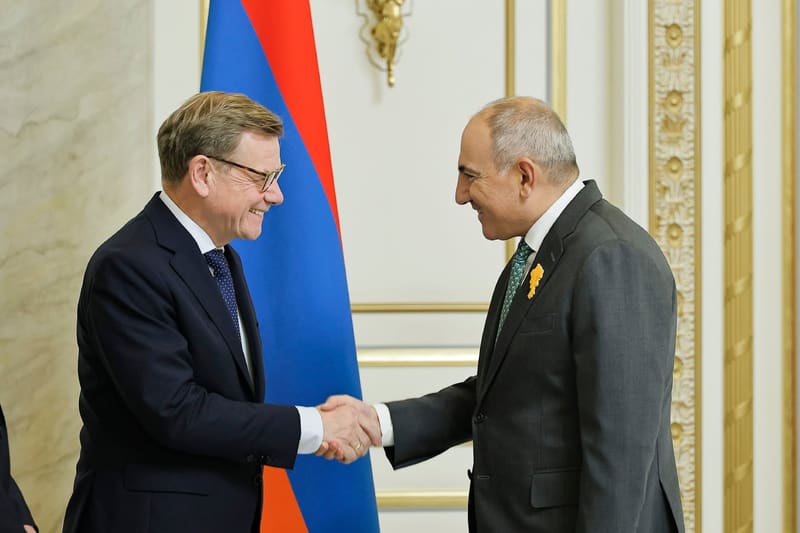
German Foreign Minister Johann Wadephul was received in Yerevan on Wednesday, 18 November, by Nikol Pashinyan and Ararat Mirzoyan. His main message: Germany supports peace between Armenia and Azerbaijan and deeper ties between Armenia and the European Union. According to the prime minister’s office, he said he was confident that the “emerging constructive atmosphere” in the region would foster regional connectivity. The two men also discussed green energy, trade with the EU and the diversification of Armenia’s economy. The same day, the German delegation paid tribute at the Tsitsernakaberd Armenian Genocide memorial, where Johann Wadephul laid a wreath. He had arrived from Baku, the first stop of his South Caucasus tour, where he met President Ilham Aliyev.
It was the second day of his first tour of the region as minister. On Tuesday, Johann Wadephul was in Baku. On Wednesday, he landed in Yerevan, Armenia’s foreign ministry said.
The schedule was busy: talks with Ararat Mirzoyan at the ministry, an announced joint press conference, a meeting with the prime minister and a visit to the genocide memorial.
With Pashinyan: peace, Europe and green energy
Nikol Pashinyan praised the “high level” of relations. He thanked Berlin for supporting his government’s democratic reforms and closer ties with the European Union. Germany, he said, is one of Armenia’s key partners within the EU. Political dialogue is “dynamic and regular”.
Johann Wadephul stressed the importance of peace between Armenia and Azerbaijan. He said he was convinced the constructive atmosphere now emerging would help open up the region and develop cooperation.
The two men discussed cooperation in green energy, trade between Armenia and the EU, and steps taken to diversify Armenia’s economy. They also exchanged views on the regional situation.
A wreath at Tsitsernakaberd
The German delegation visited the Tsitsernakaberd memorial overlooking Yerevan. It was accompanied by Armenian Deputy Foreign Minister Mnatsakan Safaryan, Armenia’s ambassador to Germany Viktor Yengibaryan and Germany’s ambassador to Armenia Claudia Busch.
Johann Wadephul laid a wreath at the monument to the genocide victims. Delegation members placed flowers by the eternal flame, then toured the museum’s exhibitions. The acting director of the Armenian Genocide Museum-Institute, Hrachya Tashchyan, presented him with a photo album.
The Bundestag recognised the Armenian Genocide in 2016.
A strategic agenda since 2025
Berlin and Yerevan signed a “strategic agenda” in December 2025, during Nikol Pashinyan’s visit to Chancellor Friedrich Merz. It covers the economy, development, education, science and culture. The two countries will mark 35 years of diplomatic relations in 2027.
Before leaving, Johann Wadephul had spoken of a “historic opportunity” for the South Caucasus. He had also warned that closer ties between Russia’s neighbours and Europe “should not be decided in Moscow”.
Analysis
The visit confirms a consistent German line: supporting the peace process without taking sides, by seeing both capitals on consecutive days. For Yerevan, the gesture at Tsitsernakaberd and the open support for closer EU ties matter. For Berlin, the stakes are also economic: the region sits on the trade route between Asia and Europe. The precise content of green-energy cooperation has not yet been detailed.
Possible consequences
The two countries are preparing the 35th anniversary of their diplomatic relations in 2027, under the strategic agenda signed in December 2025.