Pashinyan–Aliyev in Dublin: a joint readout, power grids and 105,000 tonnes of freight
- Published
- Place
- Dublin, Ireland
- Event date
- Past event —
Summary
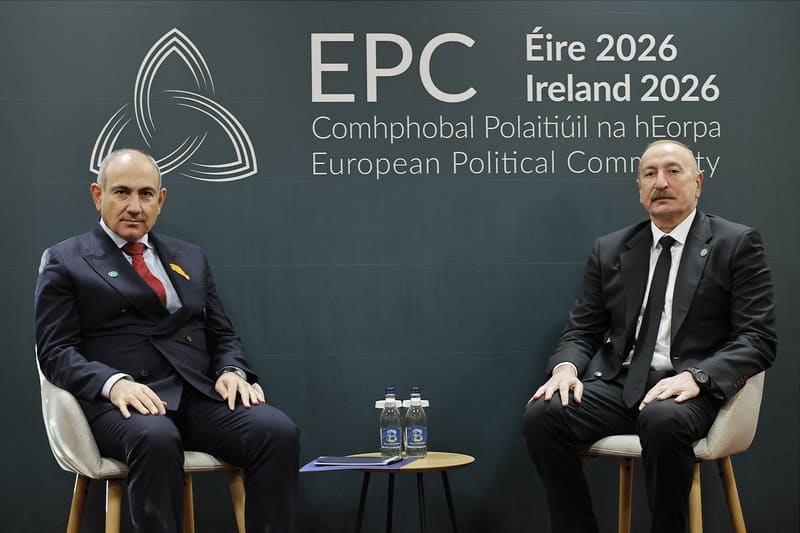
Nikol Pashinyan and Ilham Aliyev discussed transport, trade and electricity in Dublin on Thursday 12 November. Yerevan and Baku published the same readout that evening, word for word. The two leaders reviewed the TRIPP route, whose railway and highway components are in planning and design. They welcomed the transit of goods to Armenia through Azerbaijan: 105,000 tonnes since November 2025. They discussed the forthcoming interconnection of the two countries’ electricity grids. And they welcomed the creation of working groups on transboundary rivers. On the sidelines of the summit, the two countries’ foreign ministers and security officials also exchanged a few words.
The text appeared on Thursday evening on the Armenian prime minister’s website and on the Azerbaijani president’s. Same structure, same sentences. It completes Baku’s short announcement, released at 20:06 Yerevan time, which only confirmed the meeting on the sidelines of the 9th European Political Community summit.
The stated starting point is the Washington summit of 8 August 2025 and the joint declaration signed that day. The leaders discussed “practical steps” to consolidate peace: transport and transit, trade, border delimitation and confidence-building measures.
TRIPP: rail and road on the table
The core of the text is the TRIPP route, the “Trump Route for International Peace and Prosperity”. It is meant to link Azerbaijan to its Nakhchivan exclave through southern Armenia. The two leaders reviewed the planning and design of its railway and highway components, and the prospects for transit along the route.
The file is moving fast. On 7 November, Washington, Yerevan and Baku launched trilateral technical groups on transport and electricity transmission. On the very day of the Dublin meeting, Armenia’s parliament gave final approval to the framework for the company in charge of the project.
105,000 tonnes and linked power grids
The text gives one figure. Since November last year, 105,000 tonnes of goods have been shipped to Armenia through Azerbaijani territory. Both sides call it a positive development.
Another, quieter announcement: the “forthcoming interconnection” of the two countries’ electricity grids. No date, no technical detail. Finally, the leaders stressed environmental and water cooperation and welcomed working groups on managing transboundary rivers. They pledged to keep up “positive momentum”.
The other Dublin conversations
The leaders were not alone. Armenian Foreign Minister Ararat Mirzoyan and his Azerbaijani counterpart Jeyhun Bayramov had a brief conversation, according to the minister’s spokesperson, Ani Badalyan. Armenia’s Security Council Secretary Alen Simonyan spoke standing with Hikmet Hajiyev, an aide to President Aliyev, according to footage released on Thursday.
Nikol Pashinyan also met Georgian Prime Minister Irakli Kobakhidze. They discussed the bilateral agenda and regional issues.
Analysis
A single text, published by both sides: the sign of a well-oiled channel. The substance is very concrete. Freight, cables, rivers, a railway project. The peace treaty initialled in Washington is not mentioned. Nor are the Armenian prisoners held in Baku. The 105,000-tonne figure gives a measure of the trade taking shape, without saying what was carried. Yerevan and Baku are building peace through infrastructure, while setting aside the issues that divide them.
Possible consequences
Nikol Pashinyan’s working visit to Ireland ends on 13 November. No date has been given for the grid interconnection.