Brussels: Mirzoyan, Fidan and the EU at one table on the Middle Corridor and the Black Sea
- Published
- Place
- Brussels, Belgium
- Event date
- Past event —
Summary
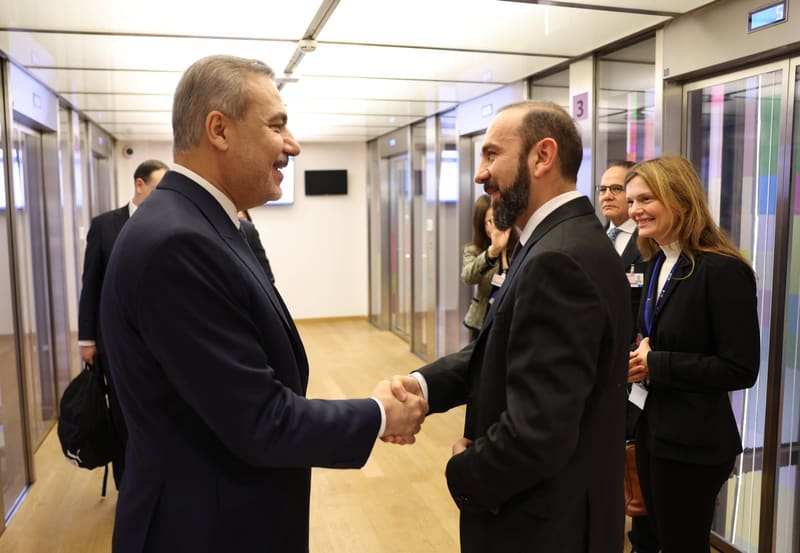
In Brussels on Monday 16 November, Armenia, Azerbaijan and Türkiye sat at the same European table to discuss roads, cables, energy and Black Sea security. Armenian Foreign Minister Ararat Mirzoyan took part in the second Ministerial Meeting on Cross-Regional Security and Connectivity. It was chaired by EU foreign policy chief Kaja Kallas and Commissioners Marta Kos and Jozef Síkela. Around them sat EU member states, Ukraine, Moldova, Türkiye, Azerbaijan and the five Central Asian countries. Mirzoyan outlined progress on the TRIPP route and called for projects with “concrete, measurable results”. The Armenian ministry published a photo of him shaking hands with Turkish Foreign Minister Hakan Fidan. The EU is betting on the Middle Corridor and is putting €50 million into a Black Sea maritime security hub.
The meeting was held right after the EU Foreign Affairs Council. It was the second of its kind, after a first edition in Luxembourg in October 2025.
According to the European Commission, participants reaffirmed their commitment to cooperate on transport, digital and energy. They described shared security and cross-regional links as drivers of peace, stability and growth.
Mirzoyan: TRIPP, from paper to the ground
Ararat Mirzoyan spoke in two discussions. In the first, on connectivity, he reviewed progress in unblocking regional links since the Washington summit of 8 August 2025. He detailed the steps taken on TRIPP, the US-backed route across southern Armenia: the legal framework on one side, work on the ground on the other.
Building or reopening these links can bring “tangible” economic benefits to every country in the region, he said. He recalled the principles of Armenia’s “Crossroads of Peace” project: inclusivity and mutual benefit. With the EU, he highlighted border crossings, simpler customs, digital trade and energy links. Political commitments must become funded programmes, involving international financial institutions and the private sector, he stressed.
In the second discussion, on the Black Sea, the minister spoke about peace with Azerbaijan and the first economic ties it is creating. He cited the dialogue with Türkiye on full normalisation and opening the border. He also denounced hybrid threats: information manipulation and foreign interference aimed at weakening sovereignty.
The EU bets on the Middle Corridor
For Brussels, the stake has a name: the Middle Corridor. Announced by Ursula von der Leyen in her 2026 State of the Union address, it is meant to link Central Asia to Europe via the Caspian, the South Caucasus, Türkiye and the Black Sea. The goal: triple trade flows and sharply cut freight times by 2030.
The Black Sea dominated the other strand. Participants discussed drone attacks on civilian ships. Kaja Kallas blamed Russia. The EU will spend €50 million on a maritime security hub co-hosted by Bulgaria and Romania. “Excessive dependencies make us vulnerable,” Marta Kos said.
Ankara claimed its place. “Türkiye’s central role is appreciated by all,” Hakan Fidan said after the meeting. Beforehand, Romania’s new foreign minister, Dan Neculaescu, had announced talks with Armenia, Azerbaijan and Türkiye on Black Sea security.
Analysis
This format has rare value for Yerevan: it puts Armenia, Azerbaijan and Türkiye into one project under European sponsorship. TRIPP and the Middle Corridor complement each other. The first opens a route across southern Armenia; the second seeks reliable routes between Asia and Europe. Ararat Mirzoyan now wants funded construction, not just statements. The handshake with Hakan Fidan is also a reminder that the Turkish file remains open: the land border is still closed. The EU, for its part, wants to turn this geography into investment.
Possible consequences
Next year the EU plans a Regional Connectivity Summit in Sofia with leaders of partner countries. The Black Sea maritime security hub is to receive €50 million.