Francophonie: Phnom Penh resolution welcomes peace between Armenia and Azerbaijan
- Published
- Place
- Phnom Penh (Cambodia)
- Event date
- Past event —
Summary
Yes, La Francophonie now formally backs peace between Armenia and Azerbaijan. Meeting in Phnom Penh, Cambodia, on 15–16 November, the heads of state and government of the International Organisation of La Francophonie (OIF) adopted a resolution on crises and peacebuilding. A whole chapter is devoted to Armenia. The text welcomes the Washington declaration of 8 August 2025 and the initialling of the peace agreement between Yerevan and Baku. It supports the TRIPP route and efforts to reopen Armenia’s border with Türkiye. It calls for humanitarian issues to be settled, including the release of detainees. It also praises Armenia for integrating refugees from Karabakh and for its parliamentary elections of 7 June 2026. It is a diplomatic win for Nikol Pashinyan, who attended the summit.
The text is titled “Resolution on crisis situations, recovery from crisis and the consolidation of peace in the Francophone space”. It was adopted at the close of the 20th summit, together with the Phnom Penh Declaration. Armenia’s foreign ministry published a summary on Monday.
Six points on Armenia
Member states “support the progress made” by Armenia and Azerbaijan in normalising relations. They encourage dialogue on “equitable, inclusive and affordable” regional connectivity. Two projects are named: the “Crossroads of Peace”, Yerevan’s flagship plan, and the TRIPP route, which is to cross southern Armenia.
On the border with Azerbaijan, the resolution backs delimitation based on mutual recognition of sovereignty and territorial integrity, in line with the 1991 Alma-Ata Declaration. That is the formula Armenian diplomacy has defended for years.
The text goes further on humanitarian matters. Settling outstanding issues, “including the release of detained persons” and the fate of the missing, will help build trust, it says. This is a clear reference to the Armenians still held in Baku.
Refugees, elections, disinformation
The OIF commends the Armenian government for integrating refugees from Karabakh. It also welcomes the “smooth conduct” of the 7 June 2026 parliamentary elections and efforts against foreign interference and information manipulation.
The Phnom Penh Declaration welcomes the results of COP17 on biodiversity, held in Yerevan in October. It also takes up education for peace, the subject of a UN resolution adopted on 4 June 2026 at Armenia’s initiative.
Pashinyan at the plenary
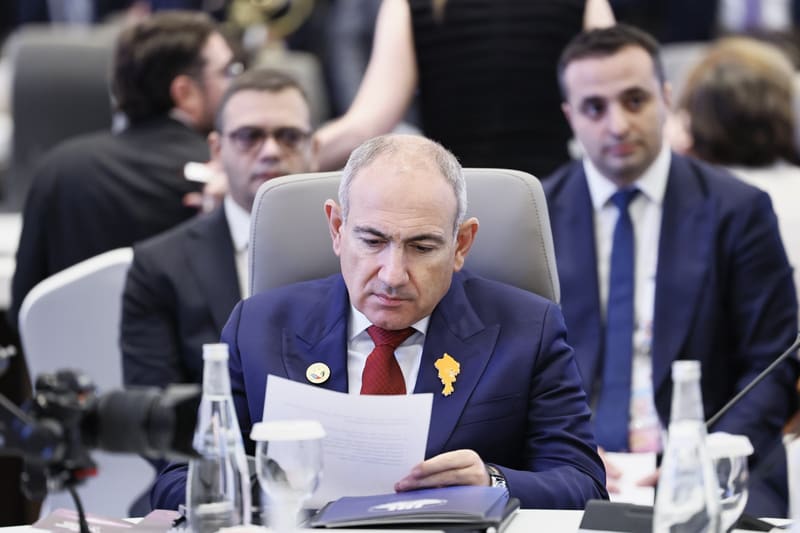
During the plenary sessions, Nikol Pashinyan spoke about peace with Azerbaijan and regional cooperation, his office said. On the sidelines, he met Cambodian Prime Minister Hun Manet, a day after meeting his Moldovan counterpart.
Analysis
Azerbaijan is not a member of La Francophonie. Yerevan was therefore playing at home, before dozens of states and governments, including France. The text is not binding. But it puts the Armenian narrative in black and white: an initialled peace deal, a border based on Alma-Ata, TRIPP and an opening towards Türkiye. The reference to detainees is the most sensitive part. After the Dublin readout said nothing on the subject, Yerevan can now point to a multilateral text. Whether that support will carry weight in Baku remains to be seen.
Possible consequences
Armenia’s position on peace, the border and detainees now appears in a text adopted by Francophonie heads of state.