Customs and taxes: Armenia signs up to the EU’s Customs and Fiscalis programmes in Brussels
- Published
- Place
- Brussels, Belgium
- Event date
- Past event —
Summary
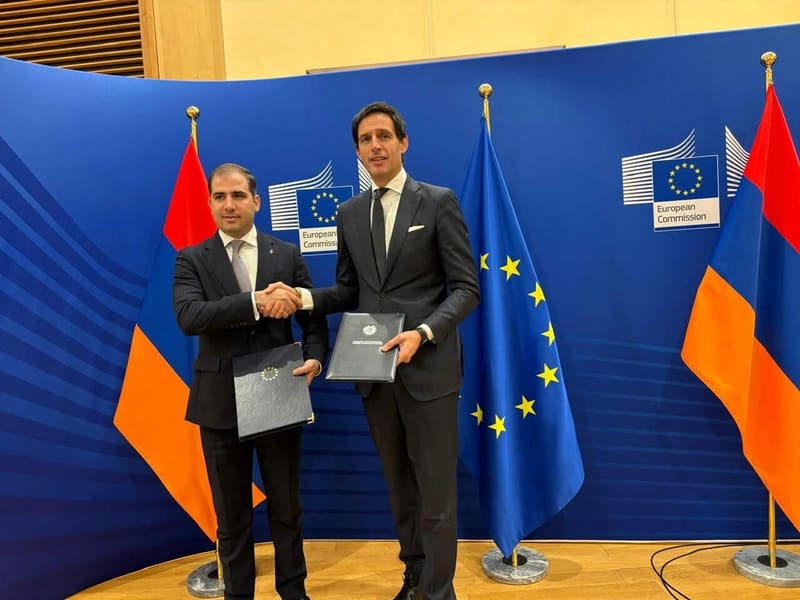
Armenia’s customs officers and tax inspectors are going to work with their European counterparts. On Thursday 12 November in Brussels, Armenia signed two agreements bringing it into the EU’s Customs and Fiscalis (taxation) programmes. Eduard Hakobyan, Chairman of the State Revenue Committee, signed them at the Berlaymont, the Commission’s headquarters, with Commissioner Wopke Hoekstra. Participation is planned for 2027, for one year. It will cost Yerevan €39,991 a year for Customs and €36,528 for Fiscalis. In return, Armenia’s administration will gain access to training, joint projects, exchanges of experience and European IT tools. The government had approved the texts on 5 November. The signing is a concrete step closer to the European Union, on very technical ground.
“This is a practical result of our Comprehensive and Enhanced Partnership Agreement,” Eduard Hakobyan wrote on Facebook. He also sees it as “a logical continuation of the Armenia–EU summit”. The two sides agreed to appoint focal points to oversee implementation. “The Armenian side is ready to immediately begin practical work,” Armenia’s chief tax official added.
What Customs changes
The Customs programme is established by EU Regulation 2021/444. It organises cooperation between the customs authorities of EU member states and non-member countries. Its aim: to protect the EU’s financial interests, fight illegal trade and facilitate legitimate trade.
For Armenia, this means modernising its customs legislation, improving risk management and digitising more of its procedures. The country will be able to join pilot projects and make its IT systems interoperable with the EU’s. In the long term, according to the ArmInfo agency, this could simplify imports and exports, and even pave the way for a connection to the European transit system.
Fiscalis, against tax fraud
Fiscalis is based on Regulation 2021/847. It links tax administrations. It aims to fight tax fraud and evasion and to make tax collection more efficient. Armenian officials will be able to train, use European information systems and exchange more data.
The cost remains modest. The contribution is calculated from the ratio between the programme’s budget and Armenia’s GDP, with an 80% reduction. Programme grants can fund IT, training and staff.
Analysis
This is neither membership nor a revolution. But it is the kind of step that counts. Customs and tax are at the heart of the state. Aligning them with European standards prepares the ground for everything else: trade, transit, investor confidence. The amount is small, barely €76,500 a year. The real test lies elsewhere: in the capacity of Armenia’s administration to absorb these methods. And in how Moscow will read this rapprochement, while Armenia remains a member of the Eurasian Economic Union.
Possible consequences
The agreements will apply in 2027, for one year. Focal points will be appointed on both sides to oversee implementation.