Armenia’s draft new Constitution: what changes, point by point
- Published
- Place
- Yerevan, Armenia
- Event date
- Past event —
Summary
Twelve chapters and 89 articles, against 16 chapters and 220 articles today. Armenia’s draft new Constitution, published on 23 November 2026 by the Ministry of Justice, goes well beyond dropping the Declaration of Independence. It touches voting rights, citizenship, parliament, the armed forces, judges, parties and the way the Constitution itself is amended. Armenia remains a parliamentary republic. The text is only a first draft: it is open to public discussion and may still change. Here are the main changes compared with the Constitution in force.
The text is online on a dedicated website where every citizen can read it and submit proposals. The announced process has four stages: public and expert discussion, approval by the government and submission to the National Assembly, debate by MPs, then a referendum. No vote date has been set.
Preamble, symbols, Church
The current preamble opens with “the Armenian people” and refers to the goals of the 1990 Declaration of Independence. The Declaration cites the 1 December 1989 decision on the reunification of Soviet Armenia and Nagorno-Karabakh. The draft begins with “We, the people of the Republic of Armenia” and speaks of a state built “within our internationally recognized territory”. Azerbaijan has made the removal of this reference its condition for signing the peace treaty.
The description of the coat of arms, with Mount Ararat and Noah’s Ark, is dropped: a law adopted by referendum will set the coat of arms, flag and anthem, and the current laws stay in force until then. The state becomes “secular”, a provision made unamendable. The Armenian Apostolic Church keeps its “exclusive mission” as the national church, but its relations with the state “are regulated” by law, instead of “may be regulated”.
Voting and citizenship
To vote in parliamentary elections and referendums, citizens would have to have lived in Armenia for at least one of the two years before the vote. The current Constitution sets no general residence requirement. Another break: it now forbids stripping a citizen of citizenship, while the draft would let a court revoke it for crimes against the constitutional order or state security. An exception to the ban on retroactive laws that worsen a person’s situation also appears, “in the public interest”.
Parliament, government, army
MPs could remove a minister, deputy prime minister or diplomatic representative by a majority of all lawmakers, and hold public hearings for nominees to these posts. Parliament could dissolve itself by a three-fifths vote. If one party wins more than two-thirds of the seats, the other forces would receive enough seats to hold one-third of parliament. With no majority and no coalition two weeks after an election, a new election would be held.
The prime minister would become commander-in-chief of the armed forces at all times, not only in wartime. The Security Council is no longer mentioned. Sending troops abroad would require parliament’s consent, except under a ratified treaty.
Judges, parties, media
All sitting judges, except those of the Constitutional Court, would undergo a one-time vetting within five years: integrity, competence and assets, reviewed by a five-member commission elected by parliament. All ten members of the Supreme Judicial Council would be elected by MPs by a three-fifths vote, against five today. A Prosecutorial Council would be created. The parliamentary opposition could nominate members to several independent bodies, including the Central Electoral Commission and the Central Bank.
Parties could be funded only by citizens’ donations and by the state. The Constitutional Court could ban a party funded from abroad or advocating the renunciation of independence. Financial transparency of the media enters the Constitution.
Amending the Constitution
Any future amendment would go through a referendum. The parliamentary threshold for putting a text to a popular vote would fall from two-thirds to three-fifths of MPs, and the “yes” would need one-third of registered voters, up from one-quarter. A transitional clause would let parliament alone decide to leave an organisation joined by treaty, such as the Eurasian Economic Union.
Reactions
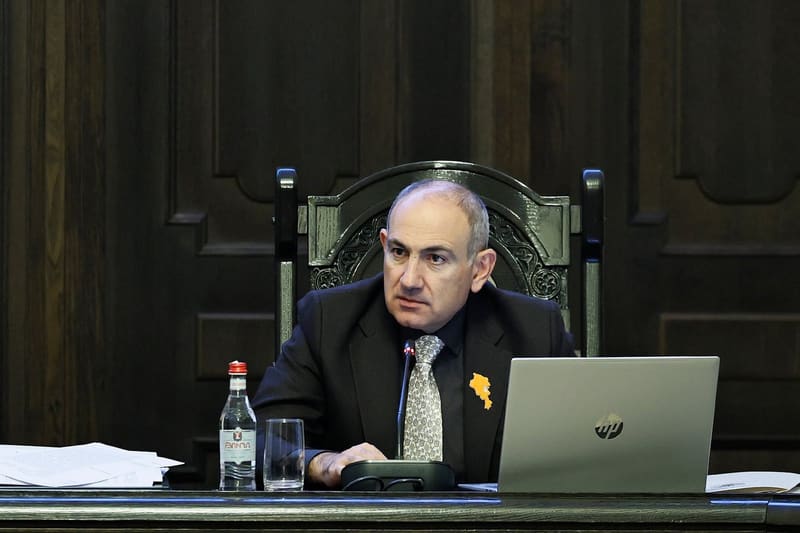
Nikol Pashinyan urged citizens not to believe the reform is being carried out “under external pressure”. His majority is six votes short of the 70 MPs needed to call the referendum. Both opposition factions rejected his offer. “Negotiations with Pashinyan are out of the question,” said Artur Khachatryan (Armenia). Tigran Abrahamyan (Strong Armenia) called it the Constitution “of a non-democratic country with authoritarian tendencies”. In Baku, Foreign Minister Jeyhun Bayramov said the published text no longer contained territorial claims and that Azerbaijan “highly appreciates” this, while calling it an internal Armenian matter.
Analysis
Public debate focuses on the preamble, but the draft also redraws the balance of power. Parliament gains tools to oversee each minister and the opposition gets seats on independent bodies. On the other hand, the prime minister becomes commander-in-chief permanently, the majority could elect some senior officials without the opposition in a second round, and every judge would be re-assessed. For the diaspora, two lines weigh heavily: the residence requirement for voting and the possibility of revoking citizenship.
Possible consequences
Nothing changes until the text is adopted by referendum. Without six opposition votes, that referendum cannot be called, and the draft may still evolve during the public discussion.
Frequently asked questions
Has the new Constitution already been adopted?
No. The text published on 23 November 2026 is a first draft open to public discussion. It still has to go through the government, the National Assembly and a referendum.
Will Armenians living abroad be able to vote?
Under the draft, only citizens who have lived in Armenia for at least one of the two years before the vote could vote in parliamentary elections and referendums.
Why is the Declaration of Independence removed?
It cites the 1989 decision on reunification with Nagorno-Karabakh, which Azerbaijan regards as a territorial claim. Baku has made its removal the condition for signing the peace treaty; the Armenian government presents the reform as an internal process.