“Helping a generation grow through rugby in Armenia”
- Interview
- Nicolas Ancelin
- Role
- Co-president of the Pan-Armenian Rugby Federation
- Company
- Fédération pan-arménienne de rugby
- Sector
- Rugby
- Based in
- Paris, France
- Published
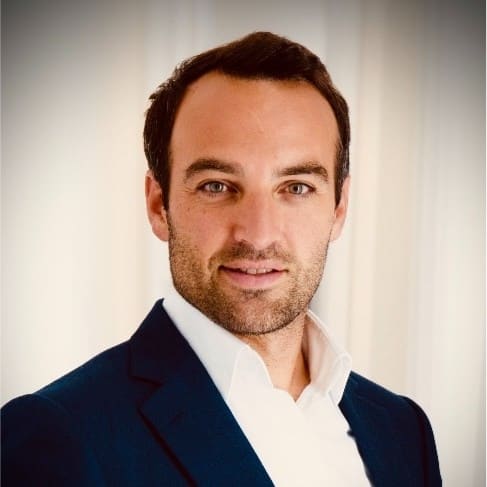
Nicolas Ancelin is French, of Armenian origin through his mother. He lives in Paris and has worked in the media for more than twenty years. A former Armenia international, he earned his first cap in 2004 and wore the jersey until 2011. With Armenia he was European champion in 2004 and again in 2006, two titles that each time took the team up a division.
Today he is co-president of the Pan-Armenian Rugby Federation, alongside Hakob Abrahamyan, a leading figure in Armenian sport and president of the Paralympic Committee. Two years ago they started again from scratch: no dedicated pitch, not a single registered player. The federation’s project, backed by the Ministry of Education, Science, Culture and Sport, is sporting, educational and societal at once.
This conversation, Barev World’s first interview, was recorded by video call on 12 November 2026 by Niels Minakian.
Rugby is made for him
Watch the interview
The interview
For those who do not know you: who are you, and what is your link with Armenia?
I am a former Armenia international. I earned my first cap in 2004. I am French, of Armenian origin, I live in Paris, and I have worked in the media for more than twenty years. My link with Armenia is my mother, who is Armenian.
The family lived in Turkey, lived through the genocide, escaped, and ended up in Syria, in camps in Aleppo, in the case of my great-grandmother, later joined by my great-grandfather. They were taken in through French and British operations, arrived in Marseille, and then moved up to the Paris region. It is a story that is, unfortunately and tragically, typical of many people in the diaspora.
I did not grow up in Armenian community life: I did not go to an Armenian school, and we did not speak Armenian at home. My grandfather himself did not speak Armenian, even though all his friends were Armenian. I knew that history well, but Armenia itself less well than I do today. My first encounter with Armenian rugby was a cultural and emotional shock, and the start of a commitment. I went to Armenia for the first time in 2004, for a home match, the first one played in Abovian. From the first training camp, we were told that a national-team player had a role as an ambassador, a responsibility, and needed to understand what Armenia was.
How does one go from Racing, Suresnes or Cergy to Armenia’s jersey, in the early 2000s?
My first contact was in 2003, and in 2004 preparations began for the European championship matches. I was called by Michel Tachdjian, a former Racing player: I was still playing when he was ending his career. I had played at Racing up to the threshold of professionalism, then stopped when I started business school: I did not have that level. Playing in the university championship, I found pleasure in the game again, and I was approached by Suresnes, then in Fédérale 2. The standard was quite high, and I rediscovered the urge to train. After Suresnes I joined Cergy, which had an ambitious project: we were promoted to Fédérale 1, today’s Nationale. Then, with work taking more of my time and the standard becoming too demanding, I moved closer to home and finished with several seasons at ACBB, the Athletic Club de Boulogne-Billancourt.
Armenia came about somewhat by chance. Michel Tachdjian, who was part of the national team’s leadership, contacted me, made sure I met the eligibility criteria, and told me there was a calendar for the Armenia team. If I was willing, I could be part of it. A few months later I was called up for a first training camp.
You were European champions with Armenia. Which titles were those?
Yes, twice: in 2004 and in 2006. At the end of the 2004 season we were European champions. We entered the FIRA championship, now called Rugby Europe, in the lowest division, and then we climbed the ranks. With each title we went up a division.
There were some fine players: Laurent Hairabetian, who was a professional, Frédéric Boyadjian, Albert Tatevossian, who was playing in England, Jonathan Torossian, and younger players such as Jacques-Antoine Bogossian, of my generation. We travelled a great deal: Hungary, Israel, Lithuania, Sweden, Switzerland, Belgium, where we went and won, in fact. It was sporting, and clearly cultural: every trip was a way of discovering the world through rugby.
Why did that adventure come to an end, and what made you want to relaunch Armenian rugby?
The adventure ended after the 2011 season. From 2004 to 2012, the federation of the time struggled to put a development plan in place in Armenia. There were national teams, an under-20 side, rounds of the European sevens circuit, but little development on the ground: poverty, limited infrastructure, people thinking first of how to get by. FIRA repeatedly asked for guarantees on the number of players, clubs and referees, and on participation in training programmes. The federation was not organised for that. In 2012 it logically disqualified Armenia, saying: you are not ready. After 2012, things slowly fell apart. There was no one to take over. Later came Covid, and then the war.
Two years ago, many of us who had stayed in touch — in France, Switzerland, Georgia — wanted to relaunch a project, having learned from the past, and to organise it differently. Not just to restart a national team: to restart rugby. The survey was very quick: there was no rugby activity, no regular training, no coach. On the other hand, about ten organisations were still registered with the Ministry of Justice as rugby federations, almost all of them with no real activity. We started again from scratch: no rugby pitch in Armenia, not a single registered player. The first real issue was infrastructure, access to grounds, and the very idea of a club, if only for insurance and to be able to welcome and protect younger players.
Where does rugby in Armenia stand today, and what are the three strands of the project?
We are running three projects in parallel. The first is local development in Armenia: increasing the number of teams, going out to the outskirts of Yerevan and further afield. We have been to Gyumri, to a village near Dilijan, to villages around Lake Sevan, and in the south, to Goris, right out into the villages, to introduce the game, raise awareness, run training sessions, and work with municipalities to get access to municipal pitches, even small ones, which at least are free.
The second strand is the training of coaches, educators and referees. We have a major project with the ministry, for rugby in schools, and we have had first meetings with the Institute of Sport, the equivalent of sports-science training in France, to bring rugby into the teaching of future PE teachers. In June, in partnership with the Georgian Rugby Federation, two World Rugby-certified coaches spent three days in Armenia and trained about fifteen people. Despite a very small budget, we would also like to send volunteers on Rugby Europe programmes, once we are recognised.
The third strand is restarting the Armenian national teams, in fifteens and sevens, women’s and men’s. We are surveying players in Armenia and across the diaspora: France, Britain, Switzerland, Belgium, but also Georgia, Iran, Russia and India. We are building a coaching staff, and from 2027 we want the first gatherings of the best players, to start work on one or more national sides. A first senior camp is planned for next spring.
What do matches such as Lions Yerevan against Iran, or Rugby Day, change on the ground?
In early October, Lions Yerevan did not just play an Iranian club: the Iranian federation eventually sent the Iran national team. We lost. There was no great difference in level, but a big physical difference, in preparation: the Lions often train only once a week, usually on a small pitch. Even so, the gap was not that wide, and they put in a very good account of themselves. We played at the Pyunik stadium, a football ground, we filled the stand, and the media coverage went beyond what we had hoped for. A national team becomes a shop window: you have to show people rugby, with a certain patriotic pride, so that parents will sign their children up.
To spread the word we also organised a Rugby Day, a big promotional day, in mid-June in Yerevan. We brought together 100 children, who arrived in the morning from the regions, and were welcomed and coached all morning in workshops run by people who had been in training for two days. 150 meals were provided that Sunday lunchtime. In the afternoon, a sevens tournament alternated matches for the children and for senior sides: two Lions teams, Liberty Eagles — a football club at heart, which wants to develop rugby — and a Georgian side that came as friends. In May the Lions had already played a club from Cyprus, on a full-size pitch. There were no rugby posts left in Armenia: an aluminium manufacturer welded three-metre tubes together to make some. It sounds anecdotal, but it is very telling.
Which clubs exist today, and where does an Armenian championship stand?
All of this is still taking shape. There are the Lions of Yerevan, whom we support, and Liberty Eagles. Another club has also organised itself on its own: it brings together mainly Russian and Ukrainian players, under a Ukrainian coach. We have been in touch with them for a year and a half; that also pushed them to start their own club last year, and they now play contact rugby.
Yes, we need a championship, school or university: that is the aim. We are moving forward with Gyumri, with Goris, and with the Armavir region, where there is interest. Around Lake Sevan, in Martuni and Gavar, training has already begun; forming a club, and funding it, is another step. You have to cover at least some of the coaches’ costs, even when a pitch is provided. We believe there is potential, and a real need among young people. Armenians have an appetite for contact and strength sports — wrestling, sambo, boxing, karate, judo, weightlifting. The cultural challenge is team sport, which is not yet a reflex for families. But rugby is for every build, every kind of ability. For now the aim is simply to grow, so that there are more and more training sessions, attracting more and more people.
How is the federation organised, around you and Hakob Abrahamyan?
The executive board has six people. Hakob Abrahamyan has been a leading figure in Armenian sport for more than forty years; he is, among other roles, president of the Paralympic Committee, and he was already on the organigram for inclusive and disability rugby. I asked him to become president, because he was the right person. He agreed, on one condition: that we co-preside. He wanted our complementarity. So we have two co-presidents, two vice-presidents — including a vice-president who is a lawyer, with a background at the Olympic Committee and the sports ministry, and who helps us with structure, legal and institutional matters — a secretary general and a treasurer.
We have created a development committee that brings together a representative of each club or team, even if it is only just starting and is not yet official. A player, English by background, now living and playing in Italy, is in charge of developing women’s rugby: in Armenia, rugby is for girls and for boys, from the outset. The Ovalian association, a French-registered association of former internationals based in France and chaired by Vincent Makinadjian, is also represented on that committee. Its president and a still-active player recently came back from a week in Armenia.
The official name is the Pan-Armenian Rugby Federation. Everything we do sits in the continuity of what has been built over the past twenty-five years. I have known two presidents, and many leadership teams. Some people are still part of the project and give their time and attention: Michel Tachdjian, Patrick Otamian, and others.
What do you need, in concrete terms, and how can an Armenian in France or in Armenia, or a friend of rugby, help?
We need everything, because this is a project starting from scratch, even if we have structured very quickly in a single year. We need communications relays, especially towards the diaspora, to promote rugby and the federation, and to support events on the ground: coaching courses, the Lions’ next matches, visits from foreign teams — Iranian, Georgian, and two French clubs working on a trip in May. We need the rugby world to send youth or senior teams to Armenia, to show the game, until the national team can play in the European championships. We need volunteer coaches, ready to spend a few days in Armenia and, given our budget, to pay for their own travel. We are very strong on hospitality.
The most important point is the search for partners, which we are about to launch, in Armenia and across the diasporas: in-kind support, financial support, and institutional partners. We are working with Yerevan City Hall on a schools tournament next spring, and we want to take a Lions match against a Georgian side to Gyumri. We need to fund buses to take children to training and to events, training courses abroad, plane tickets, accommodation. Today two or three of us are paying for that out of our own pockets. This is not a humanitarian project: it is a sporting, educational and societal one, based on solidarity, with full traceability of spending, down to taxi receipts, trips towards Syunik, or a tank of fuel to go to Stepanavan.
Follow the federation’s accounts on Instagram, Facebook and LinkedIn. When you are in Armenia, everyone can help: we need players, supervisors, coaches, people to welcome parents or children, to organise a training session, a snack, a match. There is a place for everyone, including those who have never played and simply want to come and enjoy themselves. The truth is that we have fun before, during and after the matches.
If you could say one thing to a young person in Armenia who has never seen a rugby ball, what would it be?
That rugby is made for him. Everyone who has played, or who has come to watch a match by the side of a pitch, has felt the same thing: a collective spirit, in which you enter a family. In small clubs and in big ones, you make friends for life. First of all it is a game, to have fun; those who want to can go on to a higher level. You are educated through rugby, because the collective and the commitment make you stand together. The place of the referee, of the coaches, is deeply respected. For parents, it is a sport with strong educational values. We saw it again when the Lions hosted the Iran team: a big dinner, festive, speeches, toasts, traditional dishes. There is a place for every kind of person in rugby, and it is the most open of sports. Armenia needs this sport, because it will allow a generation to come into its own and to grow, quite clearly, thanks to rugby.
Interview conducted by the Barev World newsroom, reviewed and approved by the interviewee.