Armenia visited in its depths
- Interview
- Assia Suchier-Kirakosyan
- Role
- Founder of Terres du Caucase
- Company
- Terres du Caucase
- Sector
- Scientific travel
- Based in
- Nice, France
- Published
- Updated
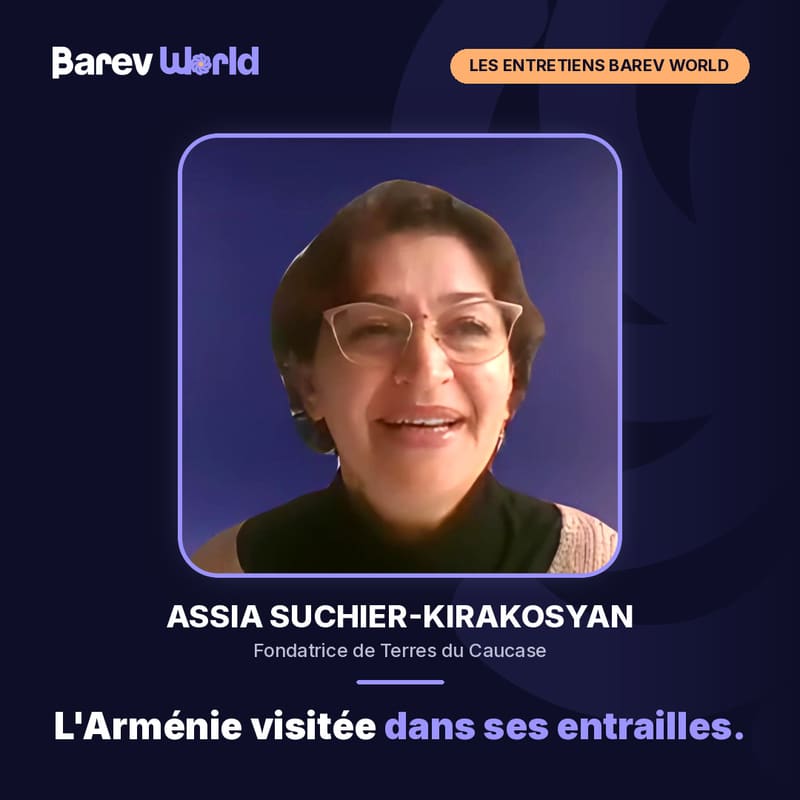
To understand Armenia, says Assia Suchier-Kirakosyan, you first have to look under your feet. The founder of Terres du Caucase takes French enthusiasts to little-known archaeological and geological sites, some of them closed to the public, with the researchers who excavated them.
In Nice, where she also runs the firm Suchier Conseil after some twenty years in human resources, she has built Terres du Caucase to “make science travel” between France, Armenia and Georgia.
She was Niels Minakian’s guest on 19 November 2026.
To understand Armenia, in this case, you first have to understand what is happening under our feet, in its soil.
Watch the interview
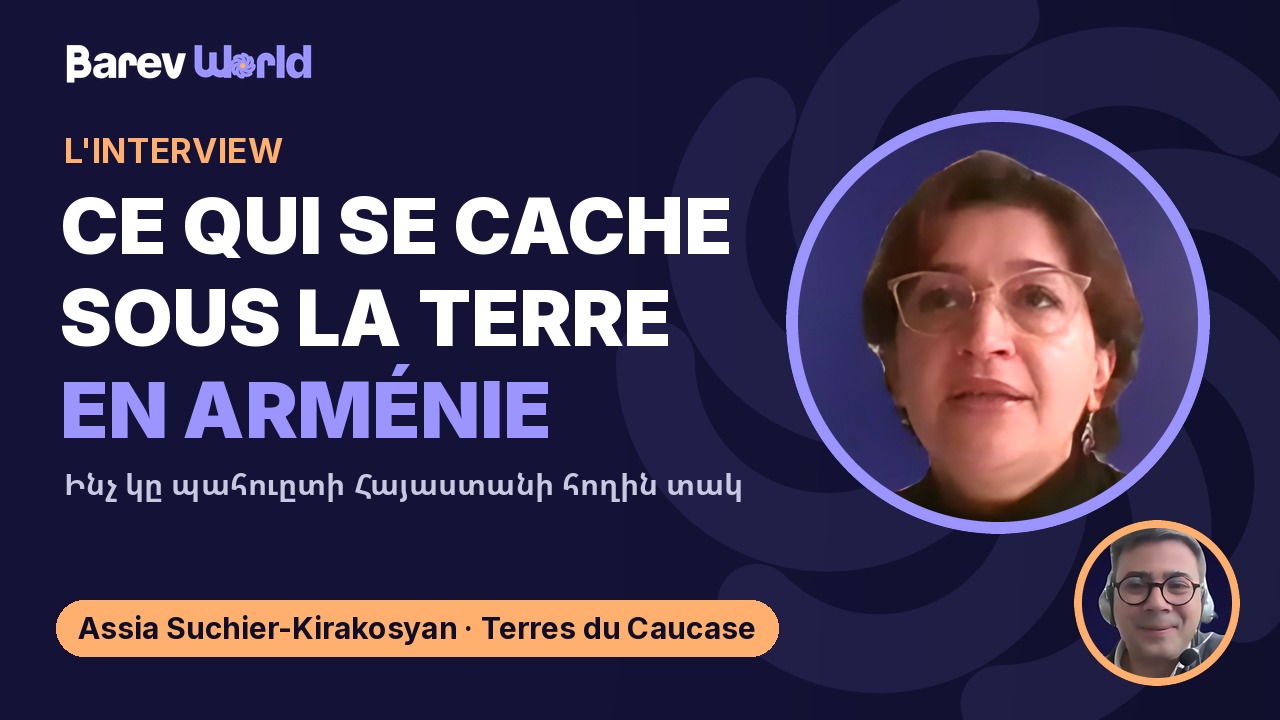
The interview
Can you tell us more about these scientific trips?
In 2017 I helped organise a geological trip to Armenia for some twenty members of an association. They came back “so fascinated and happy” that they repeated the stay in 2018. I said to myself: “If geology and geography teachers are going to Armenia, there is something there.” I discovered that French scientists from the CNRS, archaeologists and geologists, have been working there “for more than thirty years”. “There is material, there is something to talk about, I am going to go for it.”
I am aiming mainly at a French public, to “make science travel” between France, Armenia and Georgia. They are intellectuals, former teachers, former scientists, but also enthusiasts “who know far more about the subject than I do”.
What sets a scientific trip apart from a classic tourist circuit?
A classic circuit strings together churches and monasteries — Garni, Geghard, Zvartnots — and then a good table. Mine take another path.
“I take people to places that are little known and little visited, sometimes even closed to the public, because they are not emblematic sites. There is no monument to come and really say ‘wow’. Instead there are ruins, it is under the layers of the earth, what was happening several millennia ago. It is the researchers, the ones who worked on the excavations, who reveal the secrets of this land, of what lies hidden under the ground in Armenia.”
And everything takes place in French, with French-speaking researchers on the spot or French scientists from the CNRS.
Metsamor, Shengavit and the Palaeolithic caves: which closed sites do you manage to open?
Ongoing excavations are in principle closed to the public: those are what I call closed sites. Other sites, already excavated, often have no visitor facilities at all. I get access through my network, built up over several years in Armenia, and through the researchers who worked on those places.
Over about ten days, I aim for about ten “hidden” or little-known places. I can mention Metsamor, “the largest in all of Armenia”, with 27,000 artefacts, from the Copper Age to the Middle Ages, including Urartu; Shengavit; and Palaeolithic caves 40,000 years old whose “existence nobody knows about”.
Since independence, the country has been “almost an open-air worksite”.
Armenia has 500 volcanic edifices, and obsidian. What do your travellers find there?
All those volcanoes created fertile land and raw materials such as obsidian, “the raw material of prehistoric man”, worked on the spot. “Nobody knows about it, nobody goes there, and even if you go, you do not understand.”
One day an archaeologist set the travellers off on a kind of game. They all bent down towards the ground. One of them said to me: “It is absolutely extraordinary to think that 40,000 years ago, prehistoric man came here, he threw away and abandoned everything he no longer needed. 40,000 years later, we arrive and pick them up to keep as a souvenir.”
Does Areni, often described as one of the world’s oldest wineries, feature in your programmes?
It is impossible to “bypass” Areni, the country’s “visiting card”: more than 6,100 years of winemaking, among the oldest cradles of viticulture, on UNESCO’s tentative list. It is one of the most emblematic visits, and I include it in my programmes.
On a stay from which I had recently returned, the group heard one of the discoverers, Boris Gasparyan, and then tasted a wild grape variety, Vitis vinifera, “exactly as it was at the time, 6,000 years ago”.
What advice would you give a French visitor who wants to discover Armenia differently?
People often say that to know a country, you first have to understand it. “To understand Armenia, in this case, you first have to understand what is happening under our feet, in its soil. The advice I would give is to try to know Armenia differently, to go deep into what lies hidden under the ground.”
It is enough to tell me what people are most passionate about: which period, for an archaeologist; which phenomena, for a geologist. I then design a tailor-made programme. And you have to start early: “A trip is not decided on the spot.”
How can people follow you, and join a trip?
I have created a website, Terres du Caucase, and people can write to me at terresducaucase@gmail.com. I also run the page “Le Goût d’Arménie”. The programmes are designed to measure — in Yerevan, in the Aragatsotn region or elsewhere — and in Georgia as well.
For 2027 I already have four or five groups in view, “God willing”: geology, archaeology, art and culture, oenology. A programme for geologists will look at the ophiolites and sediments of a volcanic Armenia, with specialists trained in Nice and scientists from CNRS Côte d’Azur. From 20 September to 1 October 2026, I accompanied members of the Association of Friends of the Terra Amata Museum of Prehistory, in Nice.
Did you want to add anything else?
A guide once said to me: “Assia, this is the first time I am the one talking and the travellers are taking notes.” They were writing “all over the site”.
One traveller told me: “When we arrived in Armenia, we knew nothing at all about the kingdom of Urartu. Now we are leaving as Urartu specialists.” When you hear that from your traveller, you say to yourself: “Your mission is fulfilled, your mission is accomplished.”