Johann Wadephul: Armenia must change its Constitution to sign peace with Azerbaijan
- Published
- Place
- Berlin, Germany
- Event date
- Past event —
Summary
Armenia must amend its Constitution or adopt a new one before the peace treaty with Azerbaijan can be signed. German Foreign Minister Johann Wadephul said so in an interview with Tagesschau, the news programme of public broadcaster ARD, aired on Saturday 21 November. He had just returned from his first trip to the South Caucasus: Baku on 17 November, Yerevan on 18 November. “Above all, it is crucial that the agreement is finally signed,” he said. The minister acknowledged that the matter belongs to Armenian domestic politics. In practice, though, he restated the condition set by Baku. His words come on the eve of a key step: the draft of the new Constitution is due to be published on Monday 23 November. Nikol Pashinyan still needs six opposition votes to call a referendum.
The message was clear, and carefully weighed. “For a peace agreement, Armenia needs to amend its Constitution or adopt a new one,” Johann Wadephul said. He immediately added: “I am trying to support this, but of course it remains a matter of Armenian domestic politics.”
Germany’s top diplomat also described what peace could bring: new routes for goods, raw materials and energy, including electricity, and cultural exchanges between two peoples who fought for decades. A new war, he warned, would send energy prices soaring and disrupt supplies. “We cannot afford that.”
A condition set by Baku
The treaty text was initialled in Washington on 8 August 2025, in the presence of Donald Trump. Since then, Azerbaijan has refused to sign as long as Armenia’s Constitution refers to the 1990 Declaration of Independence, which mentions reunification with Nagorno-Karabakh. Yerevan replies that a new Constitution is a sovereign choice, not a concession to a neighbour.
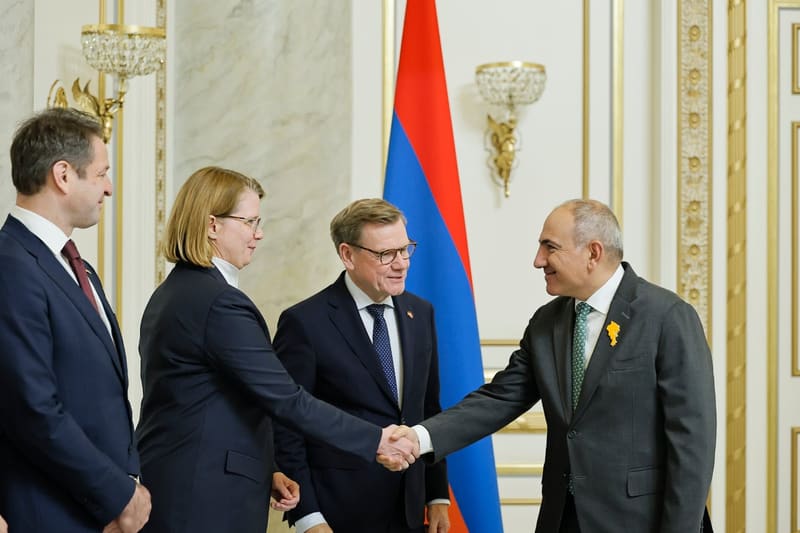
In the same interview, Wadephul called Azerbaijan a “reliable” energy partner for Germany and Europe, both seeking to diversify supplies. In Yerevan on 18 November, he had praised the Armenian government’s “big and courageous step” towards peace and accused Russia of using energy as a weapon.
Monday: the draft Constitution
The timing gives his remarks extra weight. Armenia’s Justice Ministry is due to publish the draft of the new basic law on Monday 23 November. To put it to a referendum, Nikol Pashinyan’s majority needs six opposition votes in parliament.
The prime minister has promised to step down whatever the outcome of the vote. The opposition has so far rejected the offer and is calling for early elections. It accuses the government of rewriting the Constitution under pressure from Baku.
Analysis
On substance, Wadephul said nothing new: Baku has been setting this condition for months. What has changed is who is repeating it. When a German foreign minister, just back from Yerevan, calls the reform necessary, he hands Nikol Pashinyan an argument, since the prime minister presents it as the key to lasting peace. He also hands one to the opposition, which sees a Constitution written at Azerbaijan’s dictation. The real test starts on Monday, when the text is published. Without six opposition MPs, there is no referendum. And without a referendum, no signature.
Possible consequences
The draft of the new Constitution is due to be published on Monday 23 November. Nikol Pashinyan is expected in Moscow on 3 December for talks with Vladimir Putin.