Peace Bridge: an Azerbaijani civil society delegation arrives in Armenia across the land border
- Published
- Place
- Armenia
- Event date
- Past event —
Summary
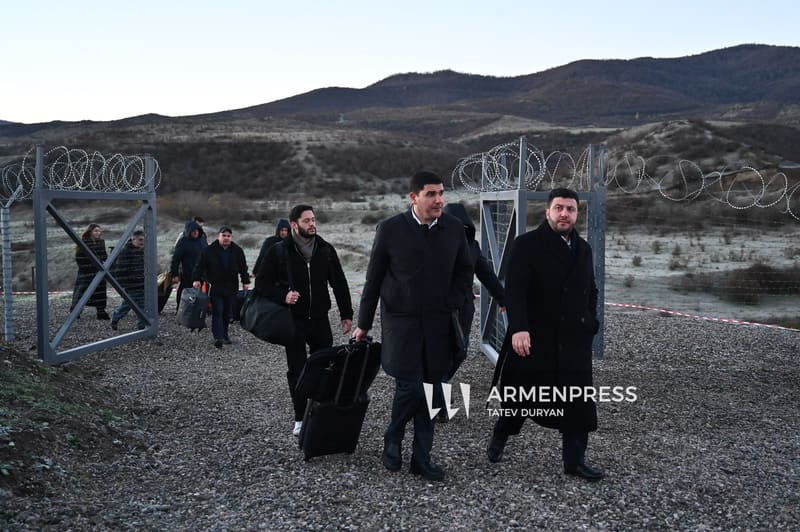
A delegation of Azerbaijani civil society representatives arrived in Armenia on Thursday, 26 November, crossing the delimited and demarcated section of the land border between the two countries. Until Friday, its members are taking part in a large roundtable with their Armenian counterparts under the “Peace Bridge” initiative. On the agenda: the peace agenda endorsed at the Washington summit of 8 August 2025, strengthening the peace process, trust between the two societies, trade and transport routes in the South Caucasus. Humanitarian issues, youth and education are also on the table. This session was supposed to take place in Yerevan in September. Baku postponed it after a row over the Armenian heritage of Nagorno-Karabakh.
Pictures from the Armenpress agency show a line of travellers, suitcases in hand, walking through an open wire-fence gate in a landscape of frost-covered hills. A little further on, under a tent, come the first handshakes with their Armenian hosts.
The announcement came on Thursday morning, almost simultaneously in Yerevan and Baku. On the Armenian side, the Armenian Council NGO issued the press release, shared by Areg Kochinyan, the initiative’s coordinator. On the Azerbaijani side, the platform sent it to the Trend, APA and Report agencies. The exact venue of the meeting has not been made public.
A broad agenda, from Washington to young people
The session takes the form of an expanded roundtable over two days. Participants are to discuss the peace agenda endorsed in Washington and ways to strengthen and institutionalise the peace process between Armenia and Azerbaijan.
They will also address measures to build trust between the two societies, opportunities for lasting economic cooperation, trade and transport routes in the region. Finally, the statement mentions humanitarian issues, work with young people, education, and the creation of direct, long-term ties between the civil societies of both countries.
A meeting postponed in September
The “Peace Bridge” was born after the Washington summit. It brings together experts, journalists and NGO leaders from both countries. Sessions were held in Yerevan on 21–22 October 2025, in Baku on 21–22 November 2025, then in Gabala, northern Azerbaijan, on 10–12 April 2026. According to Armenpress, an Azerbaijani delegation had also crossed the border to visit Armenia on 13 February 2026.
The next session was planned for September in Yerevan. It did not happen. On 11–12 September, Hikmet Hajiyev, an adviser to Ilham Aliyev, presented the Armenian monasteries of Dadivank and Gandzasar to foreign diplomats as a legacy of “Caucasian Albania”. Baku then postponed the visit “until tensions subside”. On 16 November, the Azerbaijani coordinator Farhad Mammadov announced a meeting in Armenia before the end of the year.
The section used is symbolic. Between Armenia’s Tavush region and Azerbaijan’s Gazakh district, it is the only stretch of the border delimited and demarcated, since 2024. A border that has stayed closed since the end of the Soviet Union.
Analysis
The symbol matters as much as the content. Azerbaijanis entering Armenia by road, suitcases in hand, through a border closed for more than thirty years: the image was unthinkable not long ago. Yet the dialogue remains fragile. It depends on the mood between the two capitals, as September’s postponement showed. And the platform negotiates nothing: the peace treaty, initialled in Washington in August 2025, has still not been signed. But these meetings prepare both societies for life after the conflict. Their regularity is already an achievement.
Possible consequences
The roundtable ends on Friday, 27 November. No press conference or joint statement has been announced so far.
Sources
This story is based on the following public sources:
- Armenpress (agence d’État) — armenpress.am,
- PAN.am — pan.am,
- Trend (Azerbaïdjan) — trend.az,
- Trend (Azerbaïdjan, RU) — ru.trend.az,
- Tert.am — tert.am,
- News.am — news.am,
- OC Media — oc-media.org