OSCE chairmanship: Armenia and Azerbaijan both bid, 46 NGOs say no to Baku
- Published
- Place
- Vienna (Austria)
- Event date
- Past event —
Summary
Armenia and Azerbaijan have both put themselves forward for a future chairmanship of the Organization for Security and Co-operation in Europe (OSCE). They did so on 19 November in Vienna, at a special meeting of the Permanent Council. The Swiss Chair presented a package covering the years 2027 to 2029. Austria and Norway also declared their readiness. Cyprus and Georgia reconfirmed their existing bids. No consensus was reached. Agreement among all 57 participating States is still required, ahead of the Ministerial Council in Lugano on 3 and 4 December. On 23 November, 46 human-rights organisations asked States to block any Azerbaijani bid for 2027. They called Baku “unfit” to chair the organisation. Azerbaijan has not responded officially.
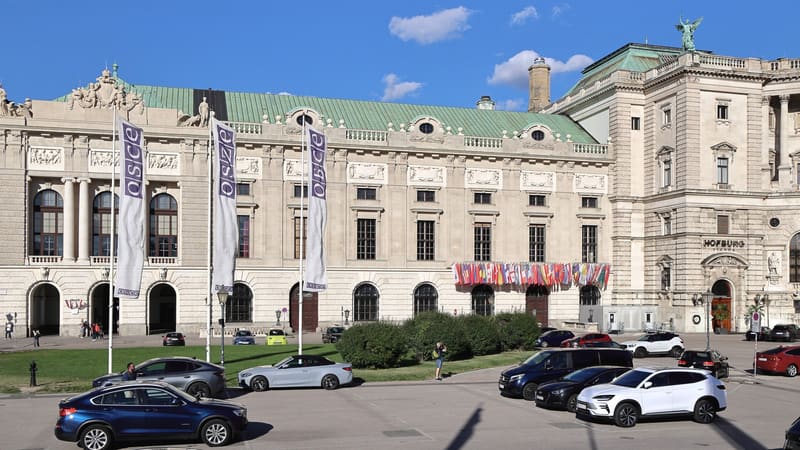
The OSCE Chairman-in-Office, Swiss Federal Councillor Ignazio Cassis, wanted to get the organisation out of a deadlock. Since Russia’s attack on Ukraine, the 57 States have struggled to agree even on which country should chair meetings from one year to the next. On 19 November, at Vienna’s Hofburg, Cassis therefore proposed settling the next three chairmanships, from 2027 to 2029, in one go. According to the OSCE statement, the principle of a three-year solution received the “broad support” of a “large majority” of States.
Four countries then said they were willing to take on a chairmanship: Armenia, Austria, Azerbaijan and Norway. Cyprus and Georgia confirmed bids already tabled, which have yet to secure consensus. The OSCE assigned no year to any country.
A package still without names or dates
The United Kingdom, in a statement delivered on 19 November, said it was open to chairs from across the OSCE area. It also set a condition: prospective chairs should show “a clear respect” for the organisation’s principles, and Ukraine should remain at the top of the agenda.
Nothing has been decided yet. The OSCE decides by consensus: a single veto is enough to drop a name. Cyprus and Georgia are already finding that out.
Forty-six organisations call for a block
On 23 November, Human Rights House Foundation and 45 other organisations issued a joint appeal. They ask participating States to block any Azerbaijani bid for the 2027 chairmanship. The government in Baku, they write, “is not a reliable security, environmental, or human rights partner” and is “unfit” to chair the OSCE.
The signatories recall a crackdown on independent civil society since 2013, intensified since the end of 2023. They cite “over 300 political prisoners”, according to Azerbaijani human-rights groups. A report by the Parliamentary Assembly of the Council of Europe counted 328 in May 2026, including 31 journalists.
The 46 signatories include the World Organisation Against Torture, FIDH, Freedom Now, the Human Rights Center of Azerbaijan, and, on the Armenian side, Helsinki Citizens’ Assembly–Vanadzor.
What this means for Armenia
For Yerevan, bidding to chair a 57-State organisation is a rare diplomatic move. For years the OSCE framed negotiations on Nagorno-Karabakh, through the Minsk Group, which was closed in late 2025 at the joint request of Armenia and Azerbaijan.
An Azerbaijani chairmanship would raise another question: that of prisoners, silenced media and Armenian sites in Artsakh. The Ministerial Council in Lugano, on 3 and 4 December, must show whether a package can still be assembled.
Analysis
Armenia and Azerbaijan find themselves, once again, on the same list, in an organisation they first used as a podium and then as the formal setting for the end of the Minsk Group. Nothing is settled: one veto is enough, and each of the two neighbours holds one. The appeal by 46 NGOs targets Baku, not Yerevan, and it will weigh most in European capitals already reluctant. Lugano, in eight days, will show whether Switzerland can still put a package together, or whether the OSCE reaches 2027 without a chair.
Possible consequences
The OSCE Ministerial Council meets in Lugano on 3 and 4 December 2026. Until then, the Swiss Chair continues consultations among the 57 States. No country has yet been designated for 2027, 2028 or 2029.
Sources
This story is based on the following public sources:
- OSCE / présidence suisse — osce.org,
- SWI swissinfo.ch (Keystone-SDA) — swissinfo.ch,
- Human Rights House Foundation — humanrightshouse.org,
- Organisation mondiale contre la torture (OMCT) — omct.org,
- OC Media — oc-media.org,
- Foreign, Commonwealth & Development Office (Royaume-Uni) — gov.uk,