Pashinyan–Erdoğan in Antalya: Armenia–Turkey normalisation runs into Baku’s lock
- Published
- Place
- Antalya, Turkey
- Event date
- Past event —
Summary
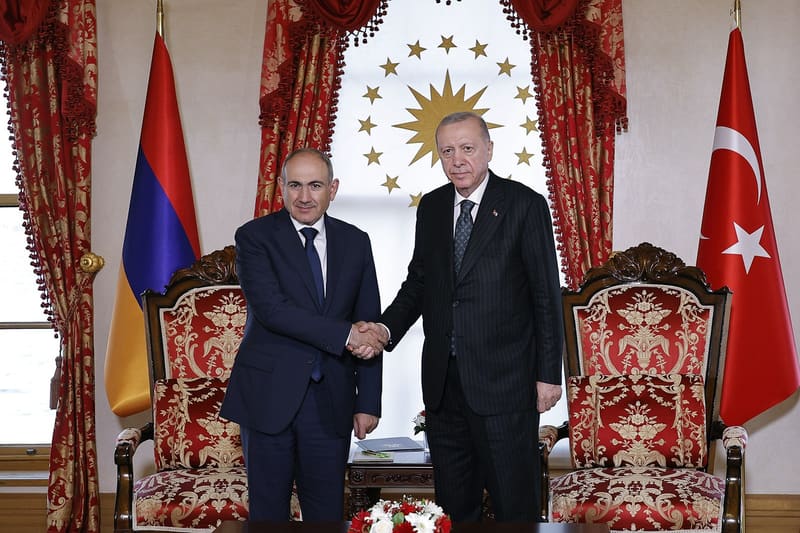
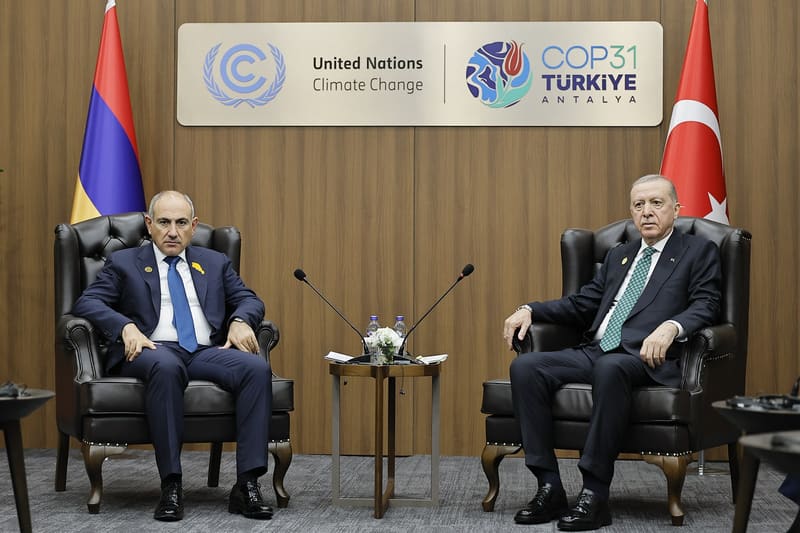
Nikol Pashinyan and Recep Tayyip Erdoğan held talks on Wednesday, 11 November, in Antalya, on the sidelines of the COP31 Leaders’ Summit. The two leaders want to bring Armenia–Turkey normalisation “to a logical conclusion”. The Armenian prime minister says he is ready to establish diplomatic relations “even today”. Ankara speaks of “symbolic but important” steps and says it is closely following peace between Armenia and Azerbaijan. No date has been set for opening the border, closed since 1993. An in-depth look at a meeting that shows how far the two neighbours have come, and how far they still have to go.
The meeting took place in the late afternoon, in a lounge at the Antalya conference centre. Two leather armchairs, two flags, the COP31 logo behind them. The foreign ministers, Ararat Mirzoyan and Hakan Fidan, were present. So was Turkey’s intelligence chief, İbrahim Kalın.
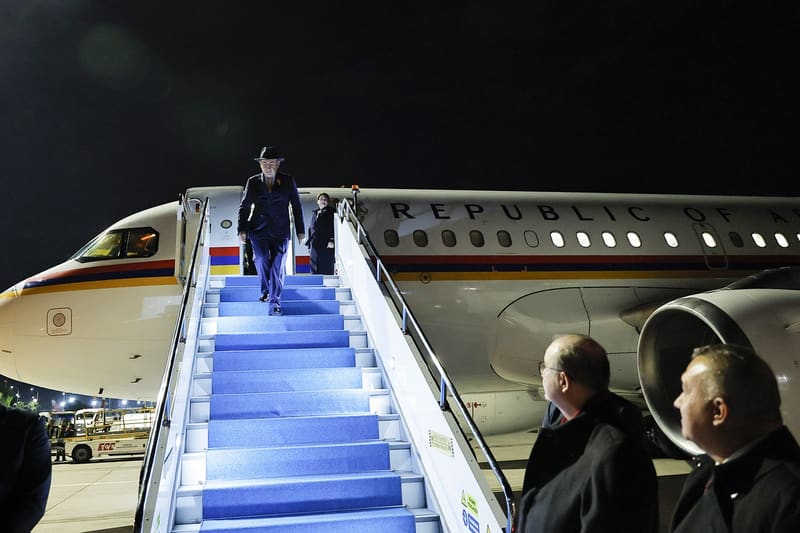
It is Nikol Pashinyan’s third visit to Turkey. He came in June 2023 for Recep Tayyip Erdoğan’s inauguration, then to Istanbul on 20 June 2025 at the Turkish president’s invitation. The two men met again on 23 September in New York, on the sidelines of the UN General Assembly. Erdoğan then invited him to the Antalya summit.
What was said in Antalya
According to the Armenian Prime Minister’s Office, the two leaders stressed the importance of advancing normalisation and bringing it “to a logical conclusion”. They highlighted the steps taken and the agreements already reached. They also want to develop trade and economic ties.
On regional matters, they welcomed the establishment of peace between Armenia and Azerbaijan, which in their view gives “fresh impetus” to cooperation. They discussed unblocking transport links, including the TRIPP project. This route is meant to connect Azerbaijan to its Nakhchivan exclave through southern Armenia.
The Turkish presidency issued its own readout. In it, Recep Tayyip Erdoğan says normalisation is continuing “with constructive steps” and that “symbolic but important” steps have been taken. He adds that Turkey is closely following the peace process between Armenia and Azerbaijan, and supports it.
Nikol Pashinyan described the talks as positive. Speaking to reporters, he said he had raised a sensitive question: why the agreements reached have still not been implemented. “Yes, we addressed all the issues,” he said, without giving the Turkish response. “We expect further developments in our relations.” An embassy in Ankara? That depends on the Turkish side, he said. “We are ready to establish diplomatic relations even today.”
From Zurich to Antalya: two attempts
The land border has been closed since 1993. Ankara sealed it in solidarity with Baku during the first Nagorno-Karabakh war. The two neighbours have never established diplomatic relations.
A first attempt failed. On 10 October 2009, in Zurich, the foreign ministers signed two protocols. One covered the establishment of diplomatic relations, the other the development of relations. They were never ratified. Yerevan suspended ratification in April 2010, withdrew the texts from parliament in February 2015 and declared them null and void on 1 March 2018.
The second attempt began after the 2020 war. At the end of 2021, each country appointed a special representative: Ruben Rubinyan, deputy speaker of the Armenian parliament, and Turkish ambassador Serdar Kılıç. They have met six times: four times in 2022, in Moscow and then Vienna, on 30 July 2024 at the Margara–Alican border crossing, and on 12 September 2025. The stated principle has not changed: normalisation “without preconditions”.
Small steps, and a stalled agreement
The record is not empty. Direct flights between Yerevan and Istanbul resumed on 2 February 2022. On 1 July 2022, the two representatives agreed to open the land border to third-country nationals and to launch direct air cargo. Ankara lifted the air cargo ban on 6 January 2023. In July 2024, they agreed to study reopening the Akhurik–Akyaka rail crossing on the Gyumri–Kars line. Since 1 January 2026, holders of diplomatic and service passports can obtain an e-visa.
Other gestures followed. Bilateral trade is now cleared through customs directly, even though trucks still travel via Georgia. The two countries are to restore the medieval Ani bridge over the Akhurian together: Turkey ran the tender, and Armenia will sign with the same company. A first Armenian–Turkish business forum was held in Kars. The next one is planned in Armenia in early 2027.
But the flagship 2022 agreement remains a dead letter. More than four years on, the border is still not open to third-country nationals. According to Nikol Pashinyan, that delay was on the table in Antalya.
A border that is ready, a key held in Baku
Technically, everything is ready. Armenia has renovated and re-equipped the Margara checkpoint in Armavir province. It has already been used: in February 2023, Armenian aid trucks crossed it after the deadly earthquake in Turkey. The day before the meeting, Turkish Transport Minister Abdulkadir Uraloğlu said his country had completed preparations at the Alican road crossing and the rail crossing.
Politically, the key is not in Yerevan. The same minister tied the opening to a mutual agreement and said Ankara would take Azerbaijan’s “sensitivities” into account. Ankara has always linked its relationship with Armenia to the Armenia–Azerbaijan peace process. The Turkish readout from Antalya makes the point in its own way, mentioning that process right after normalisation.
That process is only halfway there. The peace agreement was initialled in Washington on 8 August 2025, but it has been neither signed nor ratified. Baku first demands a change to Armenia’s constitution, whose preamble refers to the Declaration of Independence. Nikol Pashinyan’s Civil Contract kept its majority in the 7 June parliamentary elections, but not two thirds. The draft of a new constitution is due to be published in November.
TRIPP, the project that ties it all together
The TRIPP route is the thread that links these files. Announced in Washington in August 2025, it is meant to cross southern Armenia. On 28 October, the Armenian parliament ratified the framework agreement with the United States by 63 votes to 32. The first technical working groups, on transport and electricity, were launched in early November.
Ankara and Baku call it the “Zangezur corridor”. Turkey is preparing its own sections: Abdulkadir Uraloğlu expects to complete them and put them into service “in about four years”. For Yerevan, the route only makes sense if all links open, including towards Turkey. That is what the Armenian government calls regional unblocking.
The weight of images
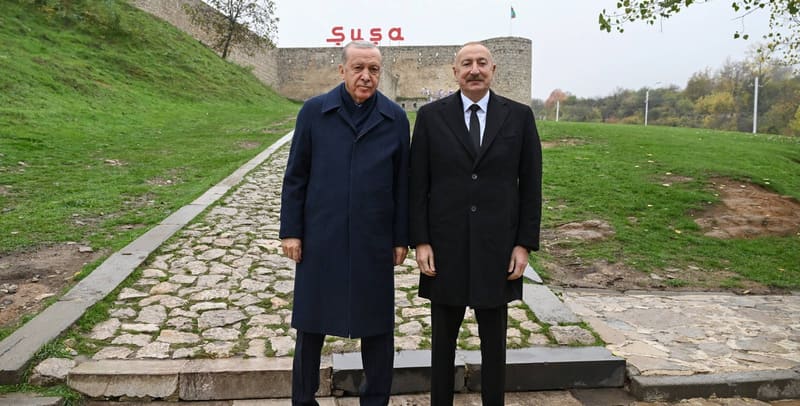
Antalya offered a rare scene: the Armenian, Turkish and Azerbaijani leaders under the same roof. Ilham Aliyev, who arrived the day before at Erdoğan’s personal invitation, was welcomed with a guard of honour. No Armenian–Azerbaijani meeting was announced.
The meeting also took place on the day the Collective Security Treaty Organisation (CSTO), meeting in Moscow, stripped Armenia of its voting rights. Yerevan has not paid its contribution since 2024. For a country drifting away from the Russia-led alliance, the image of its prime minister received in Turkey matters. On the same day, Nikol Pashinyan also met Iranian President Masoud Pezeshkian.
Video
Analysis
The two readouts do not say quite the same thing. Yerevan talks of bringing normalisation “to a logical conclusion”. Ankara talks of “symbolic” steps. The first is the language of arrival, the second the language of the journey. Nikol Pashinyan is applying pressure, politely: he says he is ready for diplomatic relations “even today” and leaves the decision to Ankara. Turkey, for its part, moves at Baku’s pace. It keeps making concrete gestures, from e-visas to the Ani bridge, without touching the main lock. The method costs it nothing with Azerbaijan. For Yerevan, it has a limit: every month of closed border feeds scepticism in Armenia. Antalya therefore settles nothing. But it was the second summit meeting in less than two months, and the question of unimplemented agreements was raised face to face.
Possible consequences
No date has been announced, either for the border or for diplomatic relations. The next steps are known. The COP31 Leaders’ Summit continues on Thursday, 12 November. In Yerevan, the draft new constitution is due this month: it will weigh on the signing of the peace agreement, and therefore on Turkey’s timetable. Work on the Ani bridge is due to start soon, and an Armenian–Turkish business forum is planned in Armenia in early 2027. No new meeting of the special representatives has been announced. The real signal will be the opening of Margara to third-country nationals, promised since July 2022.