CSTO strips Armenia of its voting rights at Moscow summit, but stops short of expulsion
- Published
- Place
- Moscow, Russia
- Event date
- Past event —
Summary
Armenia has lost its voting rights in the CSTO. Leaders of the Collective Security Treaty Organization took the decision on Wednesday, 11 November, in Moscow, at a summit chaired by Vladimir Putin with no Armenian delegation present. Kremlin spokesman Dmitry Peskov announced the move. It applies Article 25 of the Charter, which targets a member that has owed money to the common budget for more than two years. Yerevan has not paid its contribution since 2024. In practice, Armenia can no longer vote in the alliance’s bodies or nominate its citizens to posts allocated by quota until the debt is fully repaid. It has not been expelled. According to Secretary General Taalatbek Masadykov, expulsion was not even discussed. Yerevan had not officially reacted by Wednesday evening.
The decision appears in black and white in the list of documents published by the Kremlin: “On the application of Article 25 of the Charter of the Collective Security Treaty Organization with regard to the Republic of Armenia”. It was adopted by the Collective Security Council, the body that brings together heads of state. Nineteen documents were signed in total.
“Given that Armenia has not been honouring its commitments for several years, and in line with the Charter, it was proposed and decided to deprive Armenia of the right to vote, as well as the right to appoint its representatives to senior posts,” Dmitry Peskov told a reporter from Russian channel Life. Armenia was not mentioned during the public part of the summit.
A door left ajar
After the meeting, Taalatbek Masadykov set out the condition for a return: pay up. “As soon as Armenia decides to pay off its membership fees, its participation may be restored, both in terms of sending its staff and taking part in the organization’s work. The decision is up to the Armenian leadership,” he told reporters.
The day before, Sergei Lavrov had presented the draft. The Russian minister said Armenia would keep its essential rights under the treaty, including collective defence. “If they want us to kick Armenia out, we won’t do that,” he added. For Moscow, Yerevan remains a full member.
A summit without Armenia
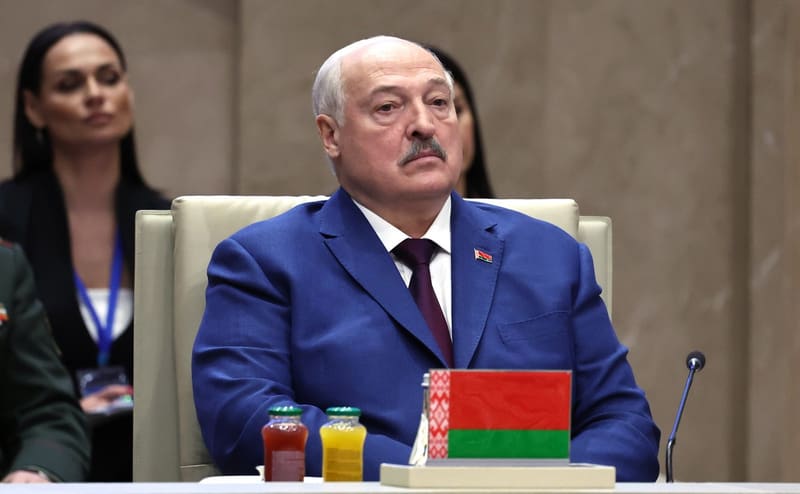
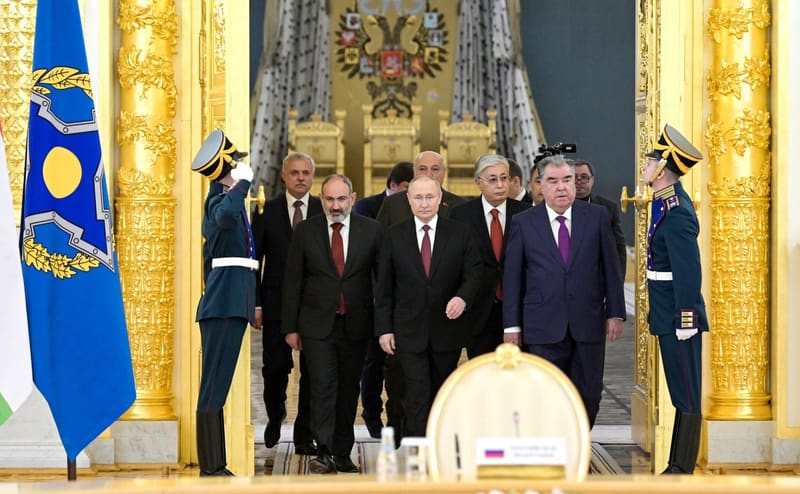
Around Vladimir Putin, in St Andrew’s Hall of the Grand Kremlin Palace, sat Alexander Lukashenko (Belarus), Kassym-Jomart Tokayev (Kazakhstan), Sadyr Japarov (Kyrgyzstan) and Emomali Rahmon (Tajikistan). The leaders adopted a joint declaration and reappointed General Andrei Serdyukov as head of the Joint Staff for three more years. Tajikistan will take over the chairmanship of the organization on 1 January 2027.
On the same day, Nikol Pashinyan was in Antalya, Turkey, for the COP31 Leaders’ Summit. There he met Turkish President Recep Tayyip Erdoğan.
More than two years of freeze
Armenia froze its participation in February 2024. It accuses its allies of failing to defend it in 2021 and 2022, during Azerbaijani attacks on its territory. It had already given up the deputy secretary general post it was entitled to. On 28 October, Foreign Minister Ararat Mirzoyan ruled out any return to the organization’s work. On 5 November, Nikol Pashinyan summed up Yerevan’s line: Armenia’s interests in the CSTO are “exhausted”. He has repeatedly said he would not object to an expulsion, without launching a formal withdrawal.
Analysis
The summit formalises a separation without a divorce. Moscow punishes the unpaid dues but refuses to pronounce the expulsion Nikol Pashinyan says he would accept. Each side keeps its line: the Kremlin does not want to be blamed for the break, and Yerevan does not want to sign a withdrawal request. The symbolism is still strong. A signatory of the 1992 treaty no longer votes in the alliance meant to protect it. On the same day, its prime minister was shaking hands with the Turkish president in Antalya. The contrast sums up the shift in Armenian foreign policy.
Possible consequences
The restrictions apply until the debt is paid in full. An official reaction from Yerevan is expected.