Firebird: $8 billion and 45,000 chips for the second phase of the Hrazdan AI factory
- Published
- Place
- Hrazdan (Armenia)
- Event date
- Past event —
Summary
Firebird is to invest about $8 billion in the second phase of its artificial-intelligence factory in Hrazdan, some 50 kilometres north-east of Yerevan. Company co-founder Alexander Yesayan announced the figure at the Digitec conference, held in Yerevan from 20 to 22 November. The new complex will comprise eight data centres, 45,000 graphics processors and 25,000 additional computing elements. It would be about fifteen times larger than the first module, opened on 8 August. The first phase cost about $500 million. Construction has already begun. Building work is due to finish in March 2027, with operations starting at the end of the same year. Once the site is fully running, in 2028, Yesayan said its effect on Armenia’s GDP could reach 8 to 10%.
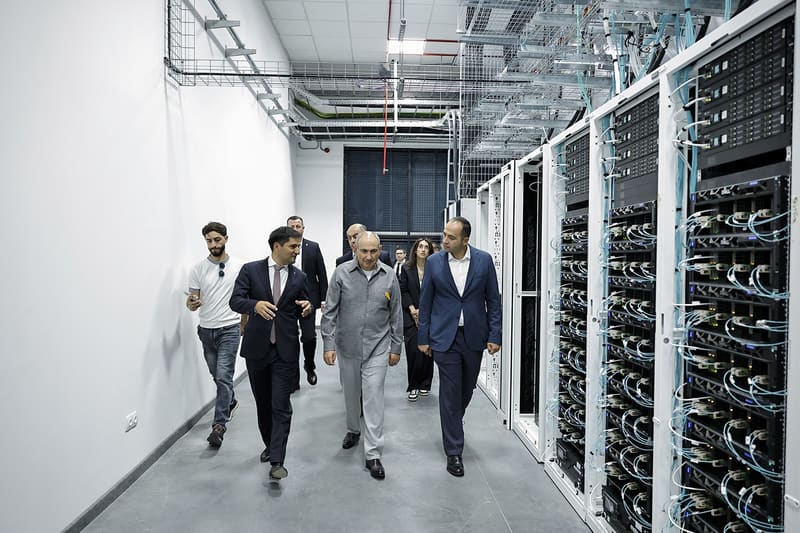
The first module of the Firebird factory has been running since the summer. It was inaugurated on 8 August, in the presence of Prime Minister Nikol Pashinyan. Investment in this first phase stands at about $500 million. The site houses a little more than 6,000 graphics processors.
Demand already exceeds that capacity. Co-founder Razmig Hovaghimian said expressed needs amount to the equivalent of 25,000 processors. Users named include Chess.com, Krisp and Perplexity, as well as public-sector clients.
Eight data centres, work already under way
At Digitec, Alexander Yesayan described a second complex already under construction in Hrazdan, with firms “working day and night”. It will include eight large data centres, 45,000 graphics processors and 25,000 further computing elements. For anyone who has seen the first building, he said, the second will be “around fifteen times larger”.
The company aims to finish construction in March 2027 and start operations towards the end of that year. Yesayan put investment in this second phase alone at “a little more than $8 billion”. Corporate income tax and other taxes, he stressed, will be paid in Armenia. At first, the effect on GDP could exceed 5 to 7%. From 2028, once the site is fully operating, it could reach 8 to 10%.
A third phase and projects abroad
Firebird also plans a third phase in Armenia. Once all three stages are complete, the country’s computing infrastructure would exceed 100,000 high-performance graphics processors, according to Yesayan. Armenia would then, in his view, rank among the world’s top ten countries for such resources.
The company is not stopping at Hrazdan. Yesayan spoke of a project worth about $6 billion in Kazakhstan. Another has been announced in Argentina.
At the outset, about 20% of computing capacity was meant for the Armenian market. That share “may increase”, Hovaghimian said, if more companies in the country develop their own products on this infrastructure.
Electricity and water under watch
The announcement comes as the government is already looking for electricity to feed these AI factories. At Digitec, Nikol Pashinyan himself tied plans to interconnect the Armenian, Turkish and Azerbaijani grids to this rise in demand. Researchers and NGOs are also concerned about pressure on water and on the grid. Firebird replies that cooling uses a closed loop, without drawing water, and that the country has an energy surplus. The government has not publicly commented on the higher investment figure.
Analysis
Eight billion dollars for a single phase is an exceptional sum: the Armenian state plans about $10 billion in spending for the whole of 2027. The advertised effect on GDP, 8 to 10% from 2028, remains a company projection, not an official figure. What matters is what actually comes online, which taxes reach the budget, and how much computing power stays in the country. Construction has already started. The real test lies elsewhere: electricity, water, and Armenia’s ability to get more than a rental fee from these servers.
Possible consequences
If the timetable holds, the second Hrazdan complex is to be built by March 2027 and enter service at the end of that year. The economic effect announced by Firebird would mainly be felt in 2028.
Sources
This story is based on the following public sources:
- NEWS.am TECH — tech.news.am,
- Radar Armenia — radar.am,
- OC Media — oc-media.org,
- Services du Premier ministre de la République d’Arménie — primeminister.am,
- Dell Technologies — dell.com,