Anahide Djabourian: Armenian wine and Domaine Djabourian’s new winery
- Interview
- Anahide Djabourian
- Role
- Head of Domaine Djabourian
- Company
- Domaine Djabourian
- Sector
- Wine
- Based in
- Aghavnadzor, Vayots Dzor, Armenia
- Published

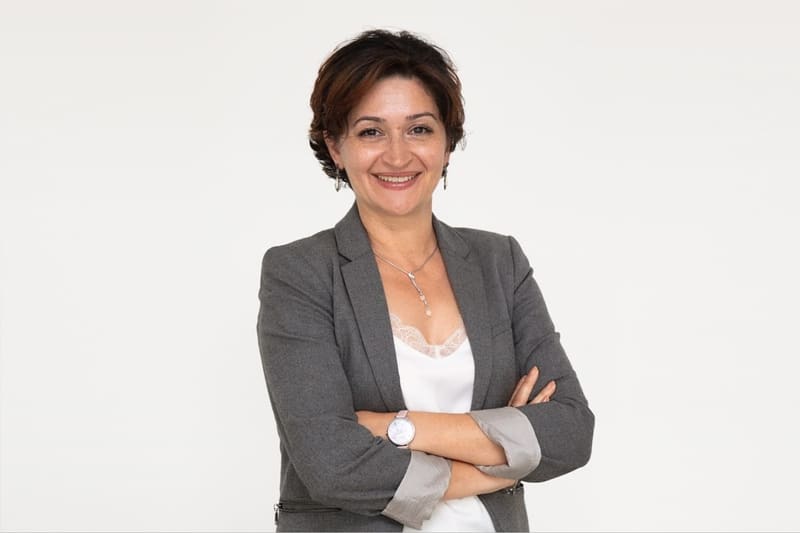
Anahide Djabourian grew up in Saint-Étienne, France, in a French-Armenian family that did not speak Armenian. In September 2021 she went to Armenia for a few months of volunteering. She stayed, learned the language and joined the wine project her father and uncle had started in Aghavnadzor, a village in Vayots Dzor more than 1,300 metres above sea level.
Domaine Djabourian works only with native Armenian grapes, Areni, Voskehat and Khatoun Kharji, with support from French specialists. This year the estate finished building its winery, and for the first time the 2026 harvest was vinified on site.
Anahide Djabourian spoke to Niels Minakian by video call on 21 November 2026.
Key facts
- Who is Anahide Djabourian?
- A French-Armenian born in France and from Saint-Étienne, who has lived in Armenia since September 2021. She runs Domaine Djabourian and lives in Yerevan.
- Where is Domaine Djabourian?
- In Aghavnadzor, a village in the Vayots Dzor region of Armenia, more than 1,300 metres above sea level.
- Who started the project?
- Her father and her uncle, two brothers, who wanted to make great wines and provide work for the people of the village.
- Which grape varieties?
- Only indigenous Armenian varieties: Areni for red, Voskehat and Khatoun Kharji for white. The vineyards are farmed organically.
- What changed in 2026?
- The winery building was completed: the 2026 harvest is the first to be vinified in the estate’s own winery in Aghavnadzor.
- Where can you buy the wines?
- In France, on the Domaine Djabourian website (delivery across mainland France) and at a few shops in the Rhône-Alpes region; in Armenia, at a few specialist shops in central Yerevan. France is currently the estate’s only export market.
For me, France doesn’t go without Armenia
Watch the interview

The interview
Who are you, and what is your connection to Armenia?
I was born in France, in the Rhône-Alpes region, in Saint-Étienne to be exact. I grew up surrounded by a family that shared Armenian culture and traditions, but I went to French school, and my best friends today are French, with no Armenian background. Almost all of them have come to visit me in Armenia.
I went to Armenian school during the holidays, but at home, unfortunately, we didn’t speak Armenian: my parents spoke it very poorly, and my grandparents spoke Turkish, which wasn’t passed on to the grandchildren. My parents were born in France, and my grandparents arrived there very young. I am a descendant of survivors of the Armenian Genocide, but my family has been in France for a few generations.
I went to Armenia regularly. The first time I was 8 or 9, and after that there were holiday trips with my parents. Always with a very special attachment.
In September 2021 you went to Armenia as a volunteer. What made you go?
Like you, I came after the events we all went through. We were watching everything from afar, I felt somewhat powerless in France, and it was very hard to see it from a distance. I told myself: I’ll go to Armenia and see what I can do there.
I contacted an organisation that allows diaspora Armenians, and anyone who wants to give their time and professional skills, to join an organisation or a company in Armenia and contribute to its economic development. I did a few months of volunteering in my field, event hospitality. It was very hard without speaking Armenian. Fortunately, in that sector, English was used, at least to some extent.
How did you learn Armenian?
I started from scratch. Many people tell me I was predisposed, but I was absolutely unable to hold a conversation. And the Armenian I had heard in France is not the Armenian spoken here: I didn’t know the Armenian of Armenia at all.
I learned it. I understand it and I speak it every day, I need it. It isn’t 100% polished yet, I should go back to my lessons. It’s a long process, it took me a few years. But when you choose to stay and live in the country you love, you have to know the language and immerse yourself in it. And Armenian is such a rich language: there are so many things you understand once you understand the language.
That’s how I got here, and I don’t regret my choice at all after five years of living here in Yerevan.
What made you stay?
After that experience, I decided to settle here. A little anecdote: my parents always reminded me how important it was to remember that I am Armenian. The day I told them I was staying in Armenia, they looked at me and said: “Are you out of your mind? What are you going to do there?” They love Armenia, they spend half the year there, but they just couldn’t imagine it.
The project that made me stay is a professional, family project: producing Armenian wine in the Vayots Dzor region. It was already in the pipeline before I arrived. Once I was there, it felt natural to turn to this project, which was just waiting for someone to develop it.
Who started Domaine Djabourian, and why in Aghavnadzor?
The idea came from my dad and my uncle, two brothers who really wanted to make wine in Armenia, and above all to bring a decent source of income to village residents. When you spend time with people in Armenian villages, you realise they are very happy, but there’s no denying that living conditions are very hard. Sources of income are very limited, and farming is sometimes the only one.
We are in Vayots Dzor, in the village of Aghavnadzor, which is known for growing grapes for wine. The idea was to help develop a local economy in a very remote rural area, to give people work, and to teach them methods they don’t necessarily know: growing grapes, yes, but to make great wines. We didn’t come to Armenia to ride the Armenian wine trend. There is a real purpose behind it.
In practical terms, how does the estate contribute to village life?
Occasionally it has been through grants. We farm this land, so we try to give something back: for example, we contributed to part of the renovation of the village school.
But this project is ultimately a business, and the main way to contribute is to employ people every day. People from the village, who can have an income to live on, stay in their village, raise their children and build a career, while learning methods to carry the project forward.
What does French know-how bring to Armenian grapes such as Areni?
We could easily buy grapes from farmers. But we wanted to make wine from grapes we grow ourselves: for us it matters to know what is in our bottle, and to oversee the whole production chain.
Grapes have been grown in Armenia for millennia, so we don’t claim, as French people, to revolutionise the way vines are grown. But we work with French specialists, agronomists, who help us introduce more modern methods, to save time or simply to be more efficient. We rely on facts, on what has been done in France.
Our commitment is to highlight this French-Armenian side. That’s who we are, and we want to own it. For me, France doesn’t go without Armenia. We make wines only from native Armenian grapes, mainly from the Vayots Dzor region, such as Areni, the variety most often mentioned for red wines, which has huge potential. Our ambition is to unite the best of both cultures: the Armenian terroir, the grapes, the altitude, combined with our French expertise. And to help the wines of Armenian producers in general find their place on the international stage.
What wines do you make today?
Red and white, and this year we started making rosé. I hope we’ll have a small rosé production every year, in very limited quantities, because rosé isn’t a wine for ageing. All our production remains very limited: these are our first years, and the aim is not to grow the stock too fast.
Today we have one range of wines and we would like to add a second. We focus on a fresher, easy-drinking, fruit-forward style. But we are already making a wine that is ageing in barrels and will give something more evolved and more robust. We farm organically in the vineyard, and we try to intervene as little as possible during winemaking.
This year you finished building your winery. What is a winery for?
It was the biggest step of the year. The winery, the cellar, is where the wines are made. We bring the grapes in after the harvest, and every stage of winemaking takes place there: in our tanks, in the barrel room if there is ageing, and then the storage of our wines. We are also creating a small tasting area, so visitors can discover how we work.
We are in a magnificent region, every season is beautiful, under snow or in autumn colours. I am very happy and very proud that this year we were able to harvest at home, in our own winery.
Before the winery, how did you make your wine?
The project couldn’t be done in full from the start. For the first vintages, around 2021 if I’m not mistaken, we harvested our grapes and took them to a kind of cooperative, a company that vinified them for us. We weren’t talking about many bottles: the aim was to understand the potential of our grapes. The results were quite positive, but we already knew we wouldn’t carry on that way. It was very expensive, and it wasn’t viable.
Then we turned to a fellow winemaker in a neighbouring village, who rented us tanks and his winemaking equipment. That was the case last year and the year before: we then had full control over the winemaking.
This year I was really afraid that, with the delays, it wouldn’t happen yet, but we made it in time. We received our tanks and our equipment, and we were ready for the harvest. This time our wines are at Domaine Djabourian, in the estate’s winery, in Aghavnadzor. And it will be that way every year from now on. It has been a year full of twists: a unique, special vintage.
Do tourism and winery visits help Armenian wine become better known?
I think they play a big part. Today a great many Armenian producers, at least those who can afford it, offer visits of their wineries with tastings. On my first trips, that wasn’t on the programme at all: until just a few years ago, agencies very rarely offered a tasting, perhaps at someone’s home.
It would be interesting to know what share of visitors to Armenia combine their stay with a winery visit. I’m almost sure it’s significant. And these people become ambassadors in their own countries. Armenia is also working to make this sector a pillar of its economy.
You export to France first. Why, and how do you sell your wines there?
We started exporting almost two years ago, mainly to France. I wanted to start there, even before selling in Armenia, because in France there is a curiosity about the story behind an estate, a desire to discover the terroir and Armenian wines. I felt it at tastings. In Armenia, drinking wine is becoming more and more normal, and there are great, very well-trained professionals, but the general public still turns to what it already knows.
We’re not trying to make a lot of noise: first we want to take root on our land and develop the vineyard and the winery. And today the Armenian market is starting to grow: people call me because they have heard about our wines.
In France we have a company that allows us to resell our wines. We sell to private customers and to professionals: networks of enthusiasts looking for unusual wines and unique terroirs, and restaurants that want to offer something different. We also sell on our website, with delivery throughout France. The Armenian community in France naturally wants to taste our wines, but they are also enjoyed by many French people.
When will the 2025 and 2026 vintages be available, and how do your wines reach France?
For the latest vintages, 2025 and 2026, you’ll have to wait a little longer, because we wanted to work on ageing: most of our wines are in barrels, for 12 to 24 months depending on the wine. We also have a 2024 red that is still ageing. The wines on sale today are the 2024 white and the 2023 red. The 2025 rosé was on sale too, but it has sold out. We hope to move to the next vintage by next spring, with a new shipment.
Transport is expensive, even more so in the current context. Our wines travel through Georgia, and sometimes the goods get held up. We just hope they are stored properly, that the pallets aren’t waiting on a dock in the sun. You have to plan ahead. For now it is an in-house system we have built, and France is our only export market. Tomorrow, with larger volumes, we hope to work with distributors and reach other markets, such as Asia or the United States. There is room, but we have to be able to produce accordingly.
What do the wines of Aghavnadzor, more than 1,300 metres up, taste like?
Our wines are typical of the region, and especially of the village of Aghavnadzor. It is an unusual terroir because of its altitude: we are more than 1,300 metres up. We have very large temperature swings between day and night, which is very interesting for vines, and, if I’m not mistaken, around 300 days of sunshine a year, which can cause some issues with water.
When you taste wines from different regions of Armenia made from the same grapes, I honestly find that Areni for red and Voskehat for white find their favourite home here. It is even more striking for the white.
For our first range, we wanted to showcase these grapes, Voskehat and Khatoun Kharji for the white and Areni for the red, without ageing, to keep them in their pure state. Wines focused on very fresh fruit, easy to drink. For the red, aromas of small red fruits, slightly candied berries. For the white, white-fleshed fruit, quince, white flowers: something very typical of our area that we wanted to preserve.
What can we wish Domaine Djabourian in five or ten years?
First, that we are still here. It still takes a lot of investment, and profitability is yet to come. Ask the greatest estates in France: it is often the next generations who reap the fruits of their ancestors’ work. I do hope to see some of the results, though.
What I would really love is to grow with the same team. Over the past few years I have seen people come and go, because farming is physical, demanding work, in France as in Armenia. The challenge is to tell them: you grow the vines, and with the winery you will have another role, responsibilities, you will learn to make wine. That can’t be learned in a few months. I am still learning myself. Nothing is guaranteed, but I would like what we have built together to last.
Where can people find your wines?
In Armenia we are in a few specialist shops in the centre of the capital. In France we have some points of sale in the Rhône-Alpes region, but the easiest way to get our wine, wherever you are, is our website, with delivery anywhere in mainland France.
And we look forward to welcoming you to Aghavnadzor to discover the estate.