Pashinyan: Armenia is “very close to the final step” with Turkey
- Published
- Place
- Dublin
- Event date
- Past event —
Summary
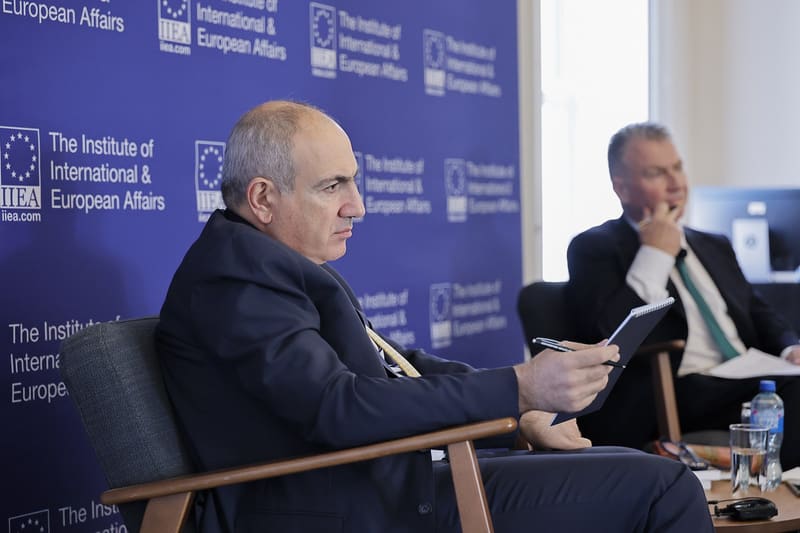
According to Nikol Pashinyan, Armenia and Turkey are “very close to the final step”: establishing diplomatic relations and fully opening the border. The Armenian prime minister said so on Friday 13 November in Dublin, speaking to experts at the Institute of International and European Affairs (IIEA). He also spoke of a “historic” chance for lasting peace with Azerbaijan that it would be “unforgivable” to miss. On Europe, he repeated that a country cannot belong to both the Eurasian Economic Union and the European Union. Yet he announced three visits to Russia in December, on the 3rd, 11th and 22nd, saying he hoped to keep a “friendly atmosphere” with Moscow. And when asked how he saw Armenia in twenty years, his answer took one sentence: a member of the European Union.
The setting was low-key: a working breakfast with the leadership of the IIEA, one of Ireland’s leading European think tanks, followed by a question-and-answer session. His remarks were reported on Saturday morning by the Armenian and Russian press.
Nikol Pashinyan was coming off two busy days in Dublin at the European Political Community summit, where he met Ilham Aliyev. On 11 November, in Antalya, he had seen Recep Tayyip Erdoğan.
Turkey: diplomatic ties and an open border in sight
“Two days ago, I had a very positive meeting with President Erdoğan. We mutually acknowledged that we have made progress and are very close to the final step: establishing diplomatic relations and fully opening the borders,” he said.
He cited one concrete change: not long ago, direct bilateral trade with Turkey was not even possible. Today, he said, the two countries trade, even though the land border remains closed.
Azerbaijan: peace “within reach”
On Azerbaijan, the tone was the same. “We have a very realistic and historic chance to establish final, lasting and reliable peace. It would be unforgivable not to seize it. This is my personal mission and the mission of our government,” he said. He acknowledged international, domestic and psychological obstacles, as well as questions linked to history.
Asked about the Armenians held in Baku, he said the issue is raised in every diplomatic contact. “We will do everything in our power to ensure that these people are released from prison,” he pledged, linking their fate to strengthening peace.
The EU on the horizon, Moscow three times in December
On the country’s direction, Nikol Pashinyan refused to speak of a change of course: Armenia, he said, pursues a “balanced” policy and is not trying to distance itself from any partner. He did recall, however, that a leader of the Eurasian Economic Union had publicly said Armenia had “nowhere to go”. That remark, he said, triggered “certain political processes”.
He then announced three trips to Russia, on 3, 11 and 22 December, “for talks”. Before giving his twenty-year vision: Armenia inside the European Union.
Analysis
The Dublin remarks are the most optimistic Nikol Pashinyan has made about Turkey. Speaking of a “final step” signals that the essentials have been negotiated. The question is whether Ankara will go all the way without waiting for a signed peace treaty between Yerevan and Baku. The prime minister is also playing on two boards: he embraces a European horizon, yet he will travel to Russia three times in one month. For Armenia, this balancing act makes sense: it cannot yet do without Moscow.
Possible consequences
The visits to Russia are scheduled for 3, 11 and 22 December. No timetable has been given for establishing diplomatic relations with Turkey.