Hookah: Armenia wants to ban it in cafés, restaurants and all public places
- Published
- Place
- Yerevan (Armenia)
- Event date
- Past event —
Summary
Armenia wants to ban hookahs in cafés, restaurants and other public places, including “herbal” versions without tobacco or nicotine. The Ministry of Health has put a draft law to that effect up for public consultation on the government platform e-draft.am. The text supplements the law on trade and services. It bans the use, sale and service of hookahs, as well as any device for inhaling an aerosol, vapour or smoke, in catering venues and public spaces. Local authorities would be in charge of enforcement. The consultation runs from 23 November to 8 December. The ministry relies on a 2022 national study: 35% of Armenian schoolchildren have already tried a hookah. At 17, more than one boy in two has. One hour of hookah smoking would expose a user to a hundred times more smoke than a cigarette.
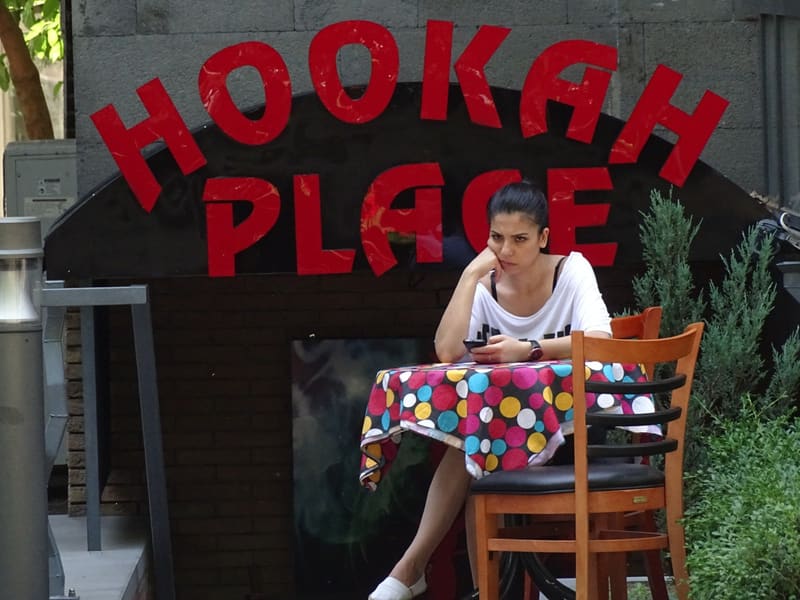
Since 15 March 2022, the 2020 tobacco-control law has already banned smoking in cafés and restaurants, indoors and outdoors. But it targets tobacco products and their nicotine substitutes. Many Yerevan venues have therefore kept serving herbal hookahs without nicotine. This is the loophole the government wants to close.
What the draft provides
The draft sets a legal definition of a hookah: any device in which the aerosol, vapour or smoke produced by heating or burning a product, with or without tobacco, passes through a liquid-filled vessel before being inhaled.
The ban does not only target hookah bars. It covers the use of such devices, their sale and any service that includes them, in catering establishments and other public places. Enforcement would fall to local councils rather than a state agency.
Teenagers highly exposed
Figures from the 2022 study cited by the ministry show a practice that rises with age, especially among boys. At 13, 18% of boys and 4% of girls have tried a hookah. At 15, the figures are 43% of boys and 13% of girls. At 17, 53% of boys and 10% of girls.
The ministry also tackles a common misconception: water does not filter out toxic substances. According to the explanatory note, herbal hookahs release carbon monoxide, tar and fine particles, sometimes as much as or more than tobacco ones. Traces of lead, chromium, nickel and arsenic have been found in some products. And the hose passed from hand to hand helps spread infectious diseases.
How to comment
Individuals and businesses can submit comments on e-draft.am until 8 December, after signing in, or send them to the ministry. The text must then be approved by the government and adopted by parliament, since it amends a law.
Analysis
Hookahs have become a night-out ritual for part of Yerevan’s youth. By also targeting nicotine-free versions, the government closes the door left open by the 2020 law and changes its logic: it is no longer just tobacco that is targeted, but smoke itself. The fight looks tougher on the side of cafés and lounges, for which hookahs are a source of income. Comments submitted by 8 December will show the scale of resistance. For families, the figures on 15- to 17-year-olds speak for themselves.
Possible consequences
The public consultation ends on 8 December. The Ministry of Health must then publish a summary of the comments received before sending the text to the government.
Sources
This story is based on the following public sources:
- e-draft.am (ministère de la Santé) — e-draft.am,
- Hetq — hetq.am,
- Aurora News (d’après Iravaban.net) — auroranews.am,
- AveNews — avenews.am,
- Tobacco Induced Diseases — doi.org